Landing rebuild, part 8: The build, three rounds on the real page, and the wind by hand.
By the Borker Team
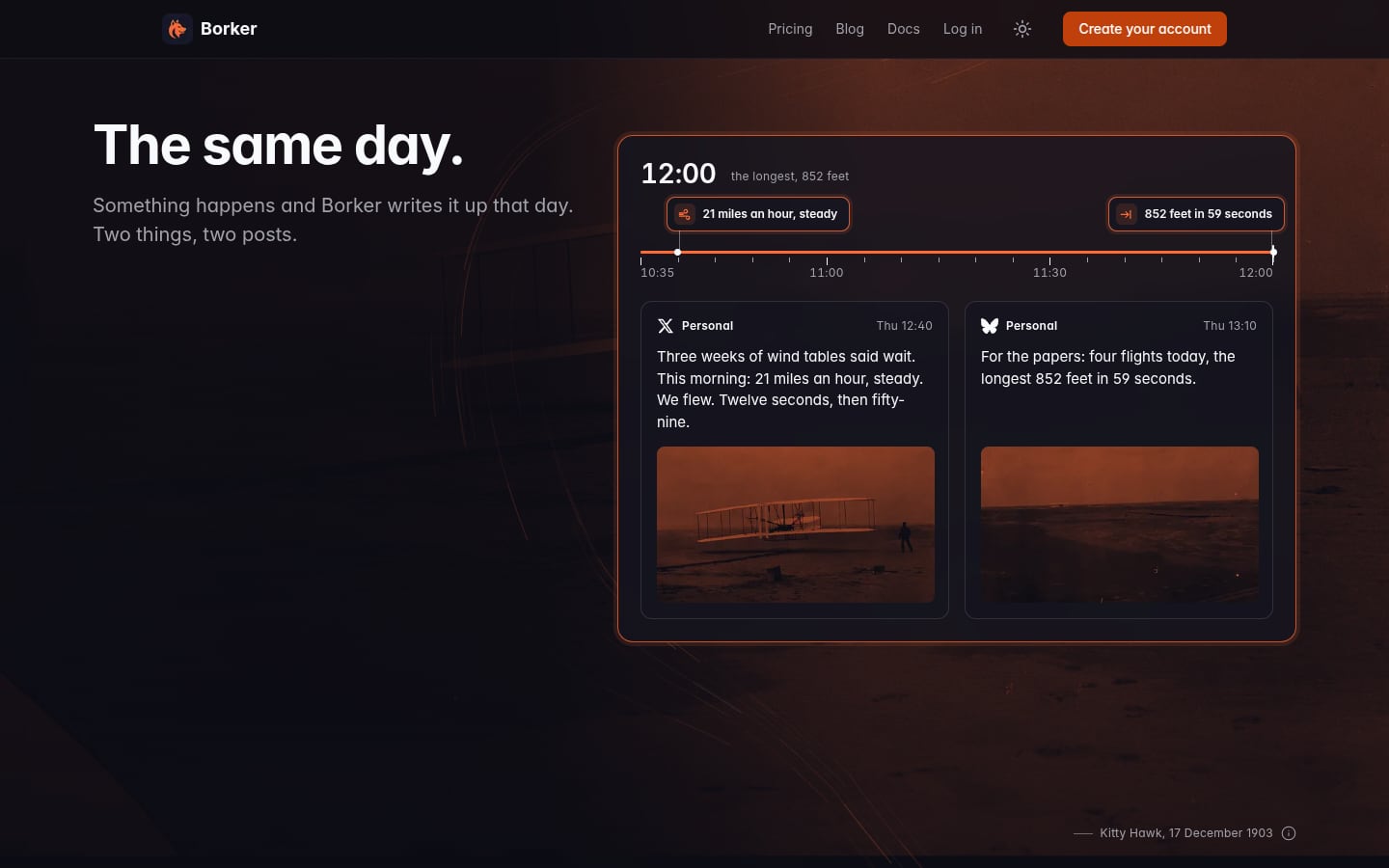
Part 8 of eight on rebuilding our landing page. Part 7 is the animatic, its numbers and the call to build. The hub lists every part. This is the part where the page gets built and goes live. The page at borker.xyz is the one this part describes, and it is still being polished.
Built as components, in one package
The architecture rule from part 7 held. The page is a short list of beats, and everything else is a module that one of those beats reads.
| Module | What it holds |
|---|---|
| The storyline | Every beat in order and every string on the page. Reorder the list and the page follows; a test does exactly that. |
| The plates | A manifest: the variant per width, the dateline, the note behind the (i), the rights line. One script re-treats any plate from its master. |
| The motion | One sheet per pair of beats, compiled into tracks. The native scroll-driven CSS and the script fallback are generated from the same tracks. A pair with no sheet crossfades. |
| The wind | One interface (mount, set the beat, pause, resume, destroy) over the lab's engine, reading one settings file. The page never knows how the wind is drawn. |
| The beats and the cards | One component per beat, one per kit card, reused across beats. |
| The stage | The pinned frame, the scroll driver, the section-seen events. |
Eight story beats on one sticky stage, each with a treated plate behind and a stylised Borker surface in front. Then the static tail: the three product steps, Is Borker for you, the plans, four questions, and the ruled close. Every "Create your account" opens account creation. The old page's visualisations, which had rendered random numbers into text on the server and again in the browser and tripped a hydration warning for months, went with the old page. The plan of record from part 2 moved into the repo as the storyline document.
Three rounds on the real page
The build was reviewed the only way this page can be reviewed: by scrolling a running copy. Three rounds, each a list of findings, each finding landed before the next look.
Round one was fourteen points. A light theme. The hero text alone on its first beat. The page scrollbar hidden. The voice cards apart. No full-bleed plates, and the wind clear of the edges. The (i) behind every dateline. The card behind the week. Two posts on the day. The tail sections at full viewport with their plates. The footer. And a wind debug mode with path editing, which the next section is about.
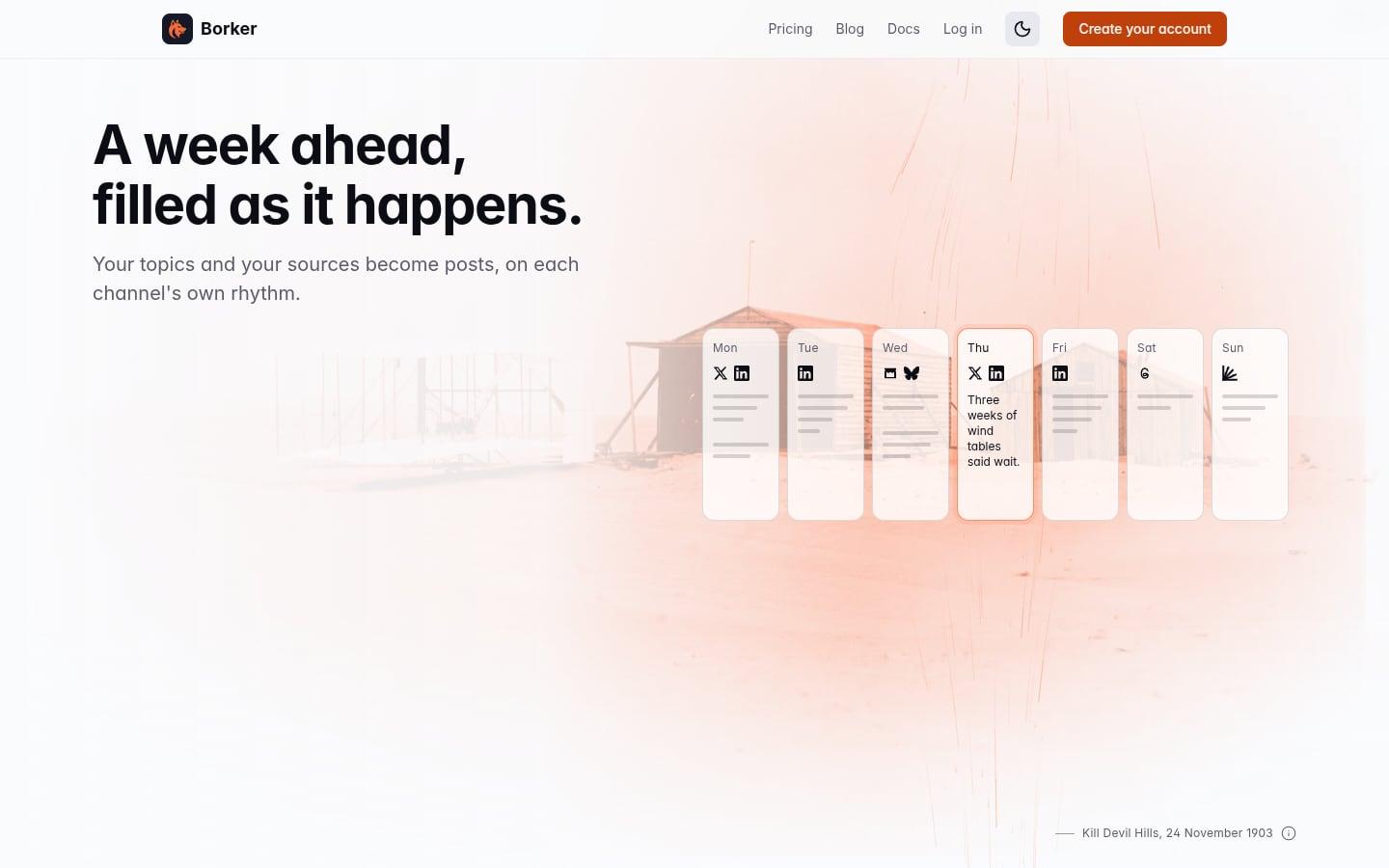
The light theme was a new plate set, not a stylesheet switch. Three ramps were made, ember, paper and sepia, and ember won: burnt shadow through the brand orange to the light ground, for all nine plates, with the kit's night literals replaced by ink and ground channels. The stage shows the theme's set and never fetches the other.
Round two was nine points.
| Finding | What was built |
|---|---|
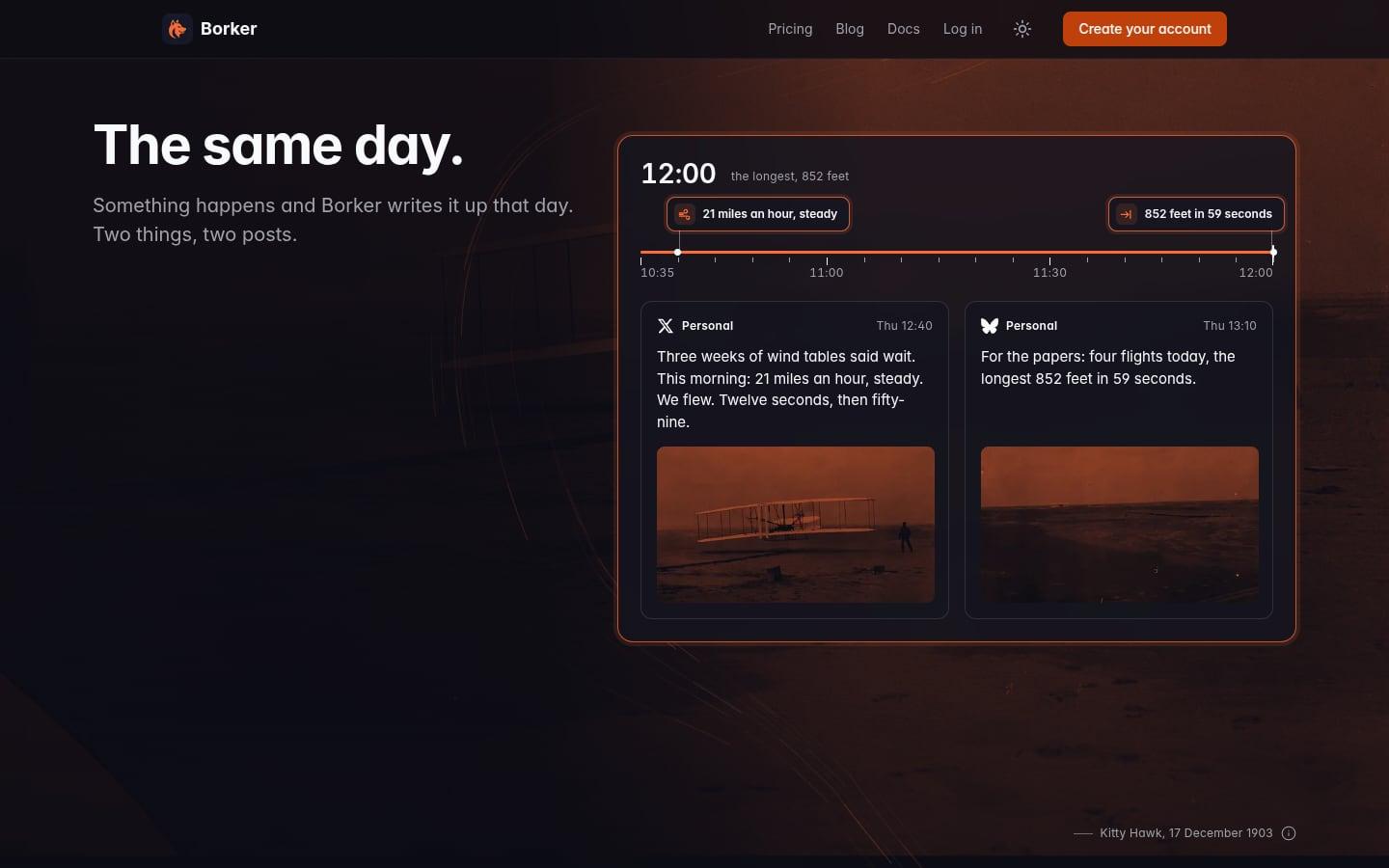
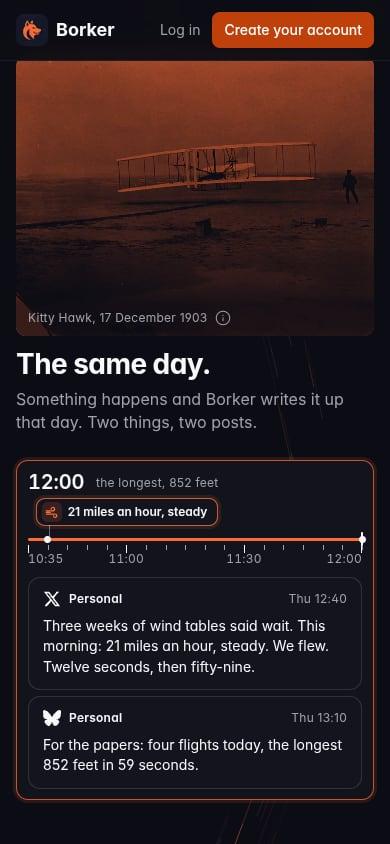
| The day's second post | A full card with the 852-foot landing beside the first, inside a wider day surface; stacked on the phone |
| The close plate still dark in light | The close follows the theme: the light plate under the light scrim |
| The three tail sections ran together | Is Borker for you takes the questions' band; the tail reads ground, band, ground, band, plate |
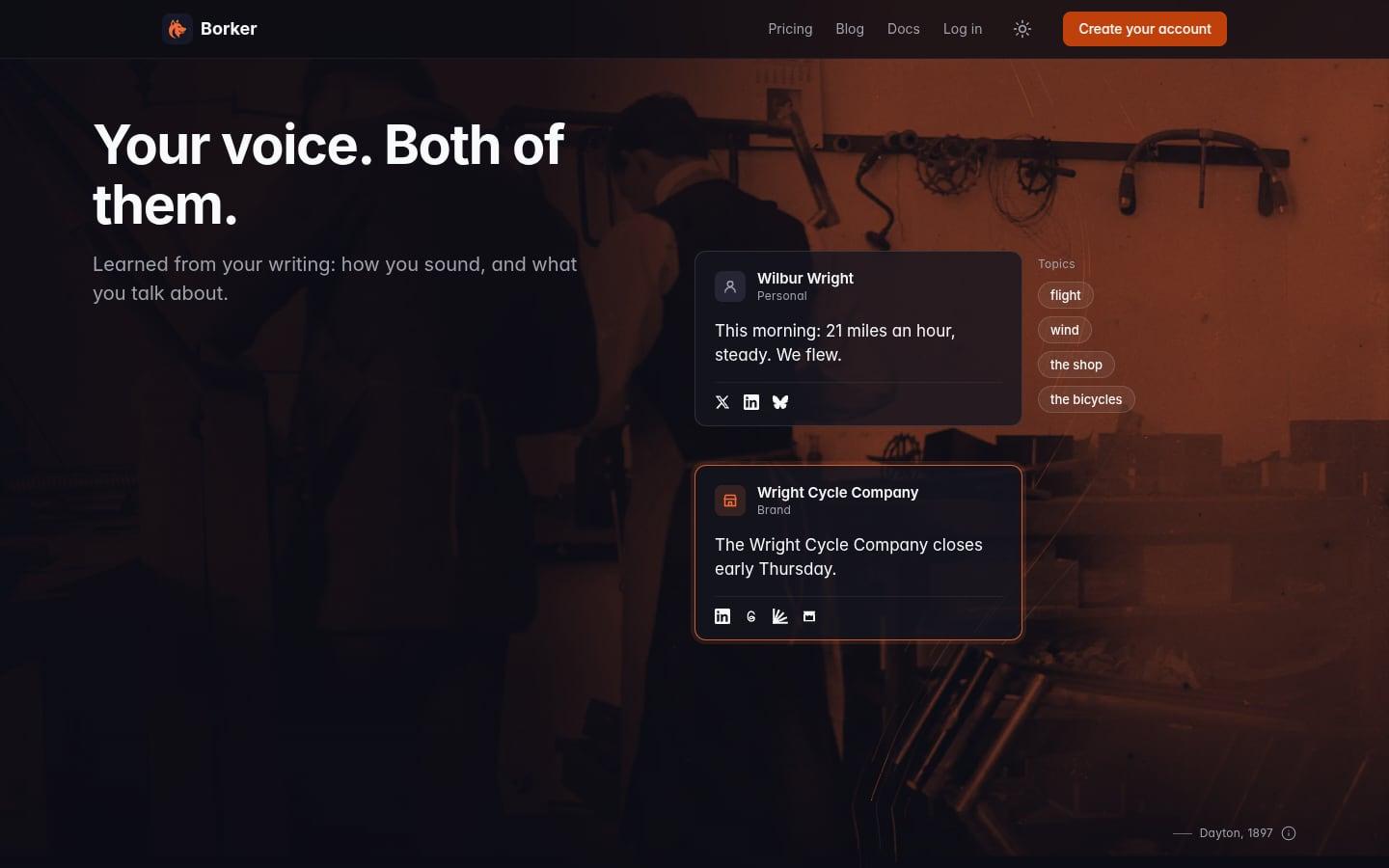
| No names on the voice cards | "Wilbur Wright" over Personal, "Wright Cycle Company" over Brand. This reverses the no-person's-name rule for one title; the storyline document says so and the lawyer's read covers it |
| Opening a question moved the section | The content sits at a fixed distance from the top; an open answer grows into room already there |
| The friction note on the close | Gone |
| The wind the same on every section | The settings file gains per-beat values, eased across each transition |
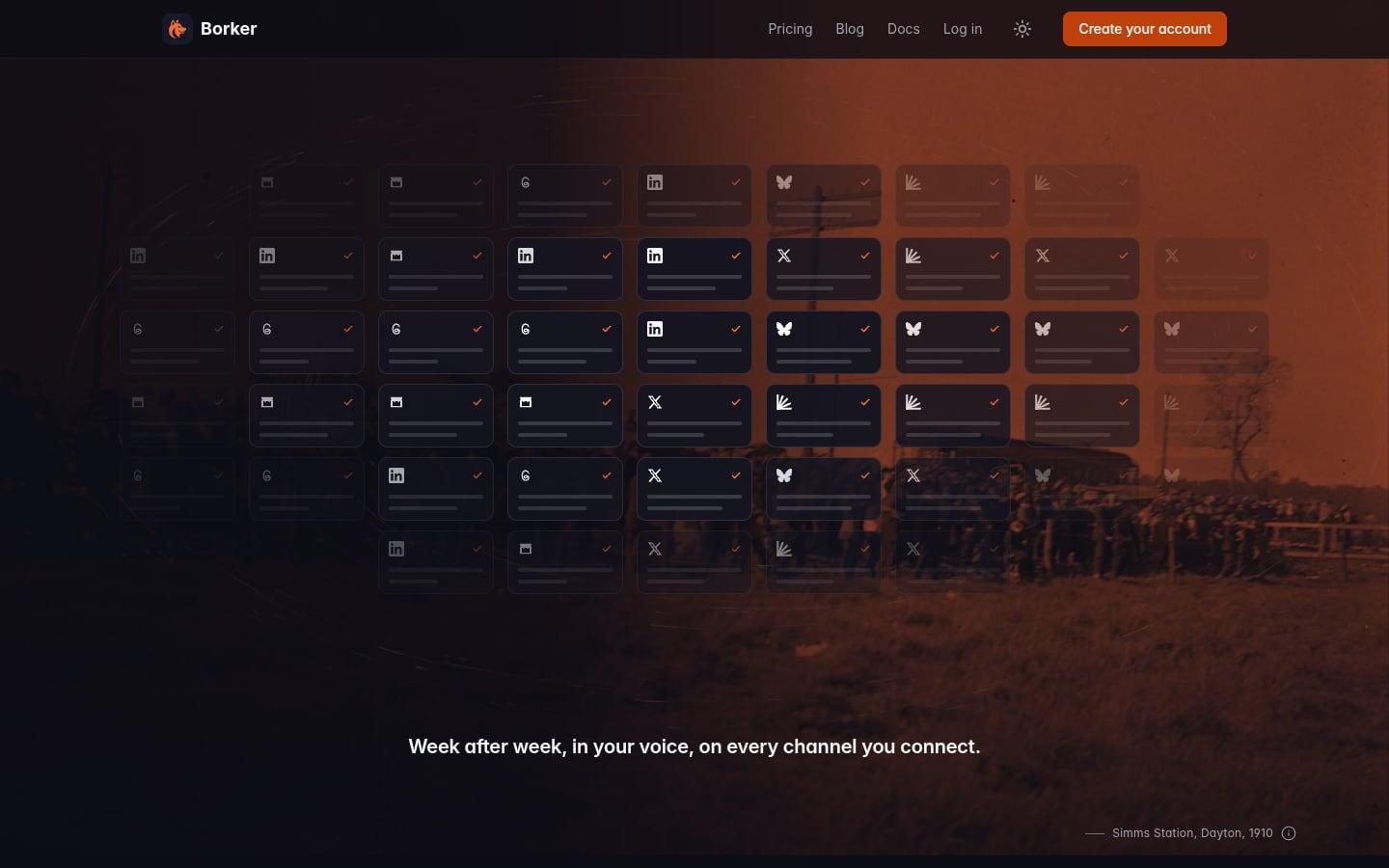
| The world beat's wind | The world's path makes two and a half turns closing in round the lattice, with an end fade so nothing piles up |
Round three was the wind, and it was mine to do by hand.
The wind, by hand
The lab from part 6 said: tune it, send the link back, and the setting is the spec. On the real page that became a debug mode behind a query string. The lab's sliders sit live over the page, the beat and its progress read out, and a path editor draws each beat's centreline with draggable handles, each point with its own width. A Copy JSON button exports the whole settings file. I tuned every beat's wind on the page itself, on the laptop first and then on the phone.
What that needed, in the order it came up:
- One path per beat. Eight beats had shared one curve. The sources gust that settled back onto the previous beat's path went, and the thread fallback with it.
- Desktop and phone as two separate winds. A phone angle had leaked onto the desktop. The file now holds two winds, each with its base, its per-beat values and one path per story beat. The tail has no wind.
- The panel on a phone: it folds to its bar, and the handles drag by touch.
- Copy from the beat before, for the sliders and for a path.
- Every handle inside the frame to start.
- One engine fix. Two points on one spot at a path's end made the exit undefined, and the beat drew nothing. The extension now takes the last distinct segment, and a test holds it.
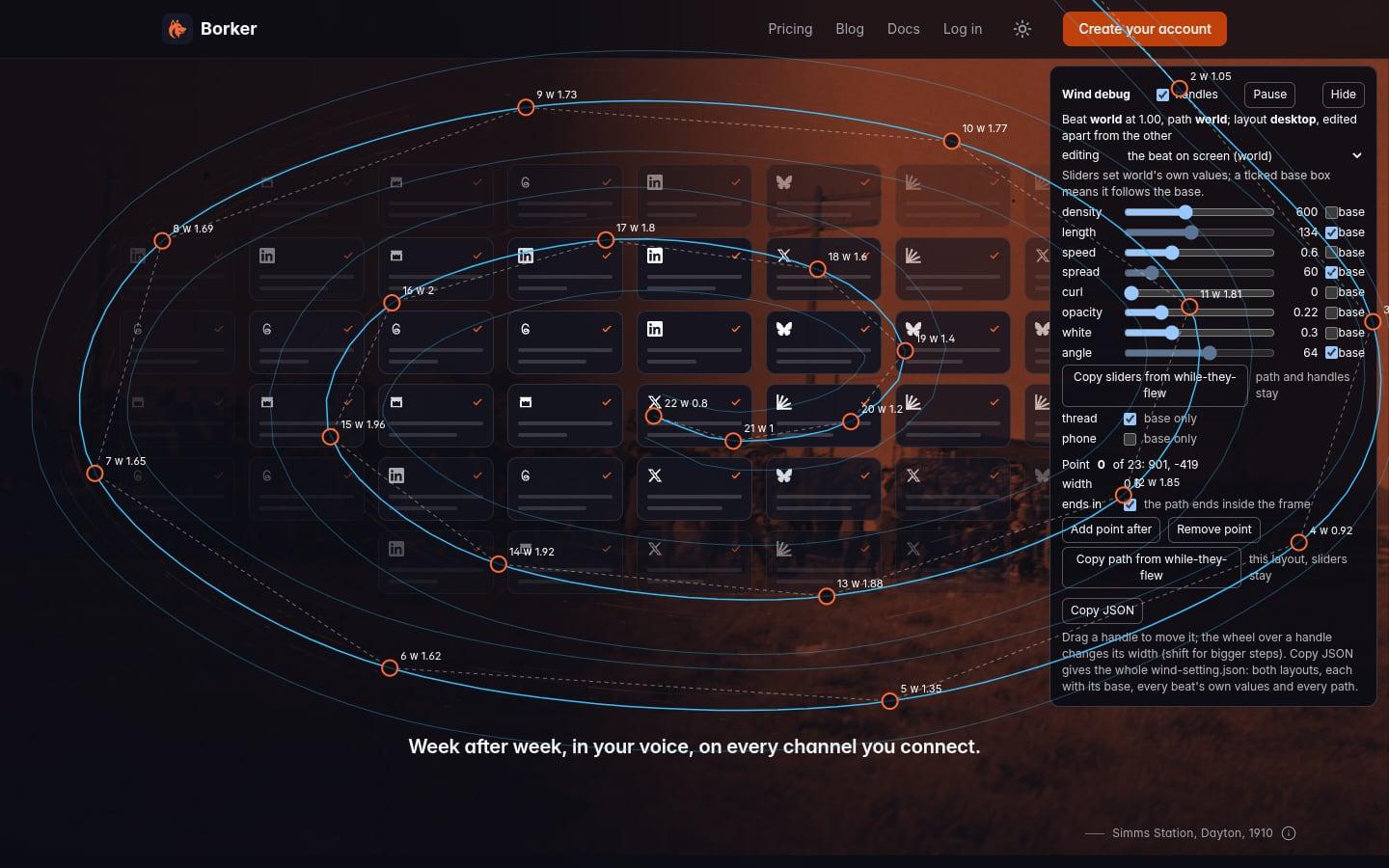
The ruled setting is my export of the third of November, both layouts, in the file. The lab is still the tool. The page did not change when the wind did, which is what the interface rule was for.
What the wind costs
Part 7 ended with the wind at a fifth of a core while idle and a rule that said it must cost the visitor's device nothing noticeable. The build measured every lever on the production build, at desktop width with a hardware GPU: whole-browser CPU at rest across the eight beats, each lever applied alone.
| Variant | Whole browser at rest | Draws a second |
|---|---|---|
| The ruled wind as tuned | 18 to 33 percent | 30 |
| Canvas at 1x instead of 2x | 18 to 35 | 30 |
| Trail segments 4 to 1 | 15 to 37 | 30 |
| Glass blurs off | 17 to 34 | 30 |
| 20 draws a second at rest | 15 to 23 | 20 |
| 10 draws a second at rest | 8 to 17 | 10 |
| Still at rest, drawn only while scrolling | 3.5 to 5 | 0 |
| The page with no wind | 3 to 8 | none |
Every draw makes the browser recomposite the whole stage, and that composite is the whole bill. Resolution, trail geometry and the glass blurs move nothing. The only lever is how often the page changes while it sits still. The page ships ten draws a second at rest, which my eye could not tell from thirty. The laptop's fans still come up on it.
So the approach itself is in question, and that is the next piece of work: the wind settling to a still a few seconds after a scroll, which the table puts at the floor, and a layer audit of the stage, where the cost while scrolling lives. The rule from part 6 is not met yet. It stays open until it is, and the page's interface to the wind means nothing else has to change when it lands.
The numbers
| Measure, production build | Result |
|---|---|
| Largest paint, desktop and phone | 288 ms and 420 ms |
| Layout shift | 0 at both widths |
| Fetched on the wire | 1,340,174 bytes at desktop, 1,259,724 on the phone; plates one beat ahead |
| Every transition, both widths | 60 fps, no frame over 33 ms |
| Main thread at rest | 1 to 3 percent of one core |
| Whole browser at rest, desktop | 8.7 to 15.5 percent at ten draws a second; 3 to 8 with no wind |
| Wind gates | 0 draws with the tab hidden, 0 out of view, a still under reduced motion |
Not proven here, as before: a real phone, where the throttled headless profile holds the renderer near its ceiling by itself, and the look, which I judged by scrolling.
Live, and still being polished
The page went to staging on the third of November and to production on the fourth, in a release with other work. The polish list from part 7 is still the list, with its state:
| Item | State |
|---|---|
| The wind's load | Open. Ten draws at rest shipped; the settle-to-still approach is next |
| The copy pass against the brand rules | Open |
| The performance budget on the real deployment, from a phone | Open |
| The lawyer's read of the names and the plates | Open |
| The deferred scroll and content adjustments | Open, each recorded before it is made |
| Weekly readings after launch | Not started; the first comes a week in |
When those land there will be one more post, on what the rebuild took in full and what the first weeks showed. Until then the eight parts here are the record, written while the page was being built, and finished the day it went live.
The series: hub · part 1 · part 2 · part 3 · part 4 · part 5 · part 6 · part 7 · part 8
New here? Borker is the AI content engine for founders.
We learn your voice, read your sources, plan your week and write each post before it goes out, while you build the actual product.