Landing rebuild, part 2: Version three shipped. The landing page did not fit anymore.
By the Borker Team
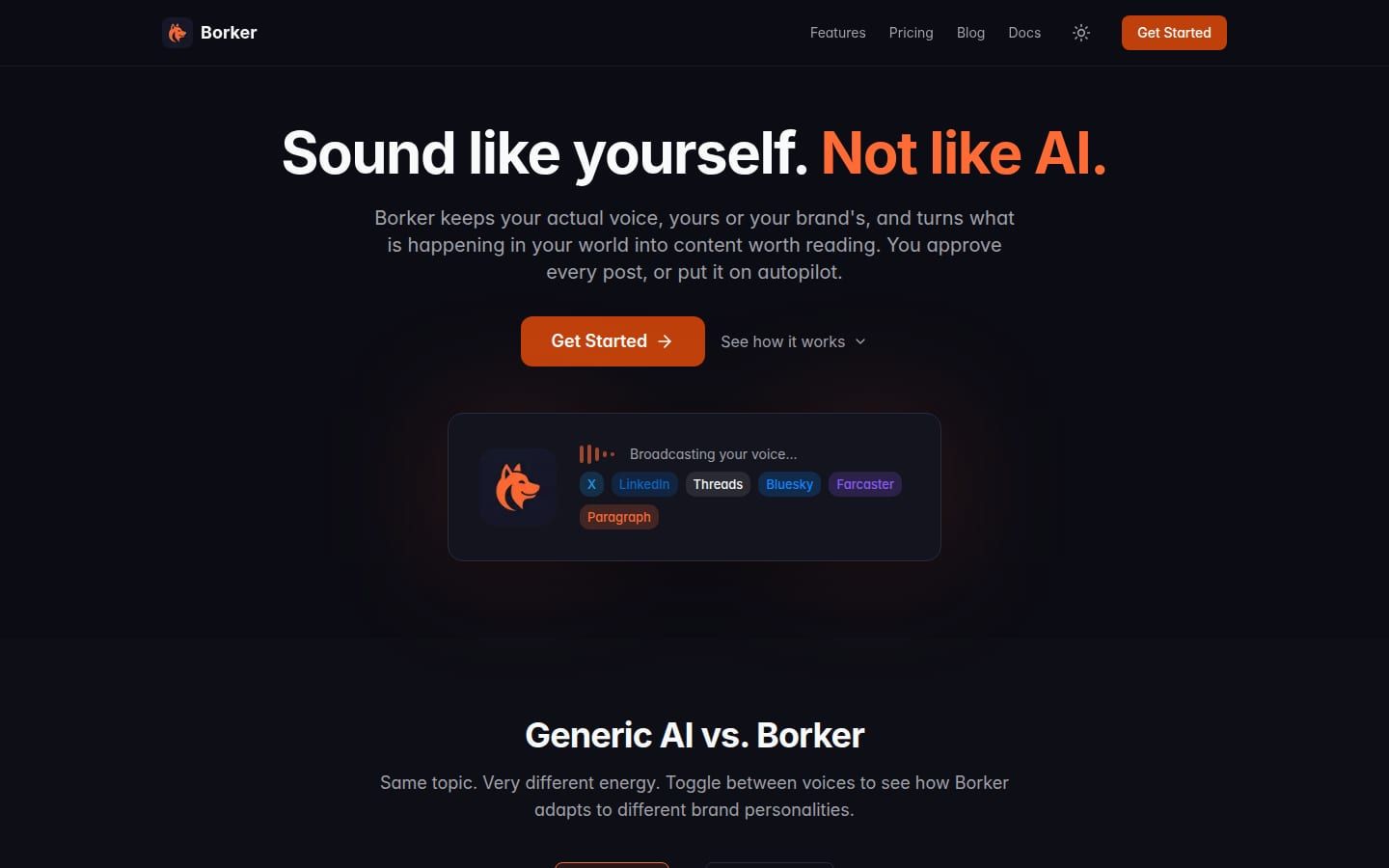
Part 2 of eight on rebuilding our landing page. Part 1 is why the product was rebuilt first. The hub lists every part.
Cutover day
Version three went live in the middle of October. I opened the landing page the same day, the way you check a room after moving the furniture, and found the old product still on it.
The page sold campaigns, calendar slots and a daily run. None of those existed any more. Four different headlines were live across the site at once, because each had been written at a different point in the year. The root page title called Borker a scheduler, which is the one word we had decided Borker is not. The docs described the old mental model page for page.
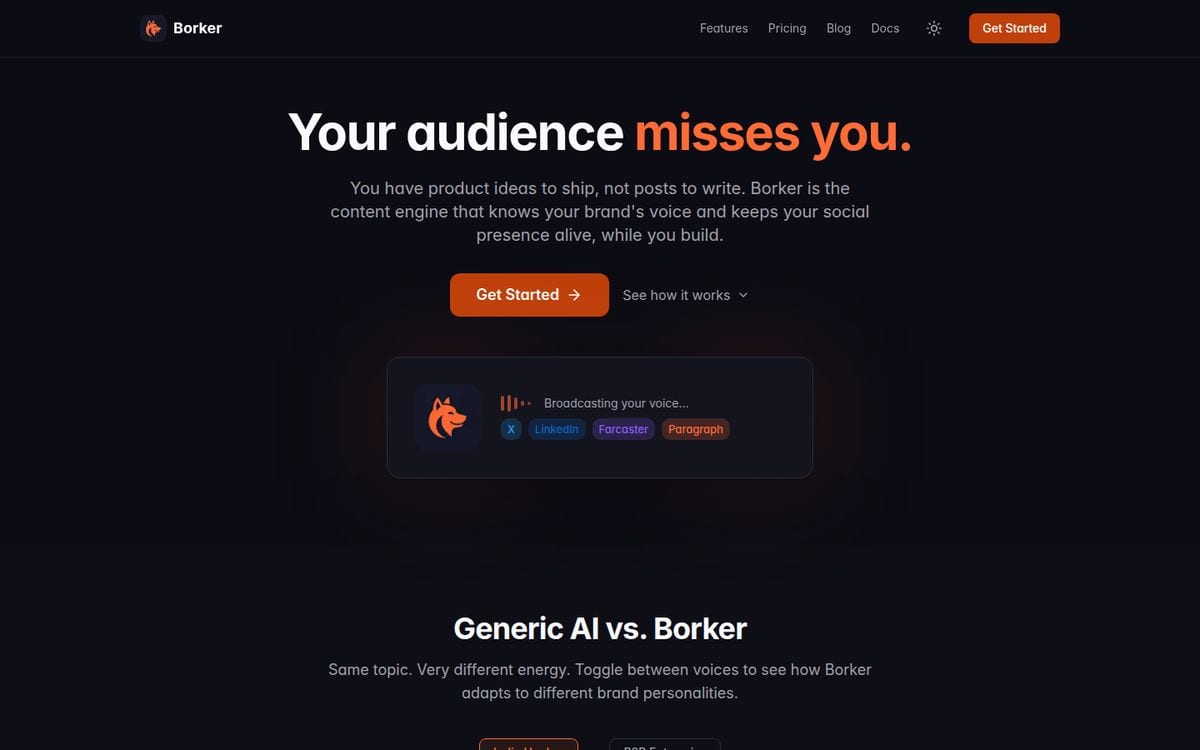
Worse than the stale facts was the shape. The page had the disease the product had. It was too nerdy. It was a list of mechanisms, written to impress people like me. It explained instead of telling. A visitor who had never heard of Borker got a feature sheet with better adjectives, and a visitor who had been burned by AI drafts before got nothing that would change their mind.
The words first
The cheap fix came first, because the rest would need it. We wrote one brand statement set, seven lines in one file:
- a hook
- a product line
- a subhead
- a definition
- a short definition
- a site title
- a site description
Every surface that says what Borker is renders one of those lines from one module, and a unit test holds the module identical to the file. Change either without the other and the build goes red.
The set is small enough to print.
| Line | Text |
|---|---|
| Hook | Sound like yourself. Not like AI. |
| Subhead | Borker keeps your actual voice, yours or your brand's, and turns what is happening in your world into content worth reading. You approve every post, or put it on autopilot. |
| Definition, short | Borker is a content engine for founders and brands. |
| Close | Sound like yourself. Start with a real week. |
The rules the set carries are the rules every piece of our copy now follows, this series included. No em dashes. No sentence joined with a comma and "so". Second person. No hype verbs, no AI-isms, no emoji. Numbers in a table, never in prose. No line names a channel: we say "every channel you connect", and a surface that has to list channels reads the channel catalog. A failure message names the cause and one action.
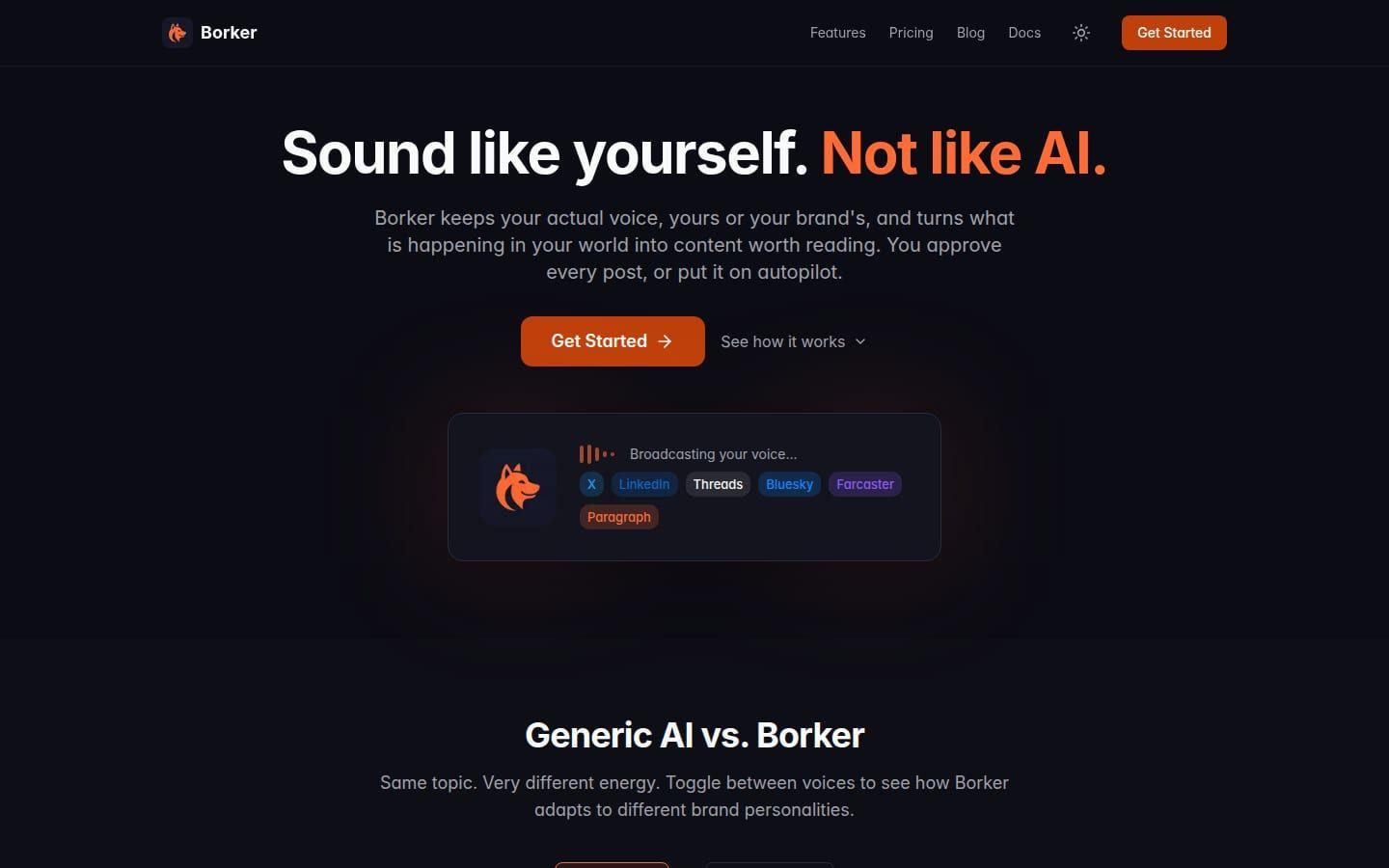
With the words in place we put the hook and the subhead on the old hero. That is the picture below, and it made the gap obvious. Right words, wrong page.
What we may claim
The next thing we wrote down was a claim sheet, read against the code. A landing page lives or dies on whether a sceptical visitor can catch it in a lie, and every tool in this category has been caught.
| Safe to say | Not yet | Never |
|---|---|---|
| Writes in your voice, from a model built on your own writing | Voice authenticity as a solved problem | An AI head of content |
| Starts from what is happening in your world, not from your archive | Reading your long-form writing | Grow your following |
| One thing happened, one post per channel, each in the channel's shape | Any traction number | Schedule your posts, as the identity |
| Publishes directly to every channel you connect | Any superlative | Engagement bait, growth hacks, a persona you do not have |
| Approve every post, or autopilot with the sensitivity and quality gates still applied | ||
| An agent API and an MCP, for the builder reader only, never in the hero | ||
| Paying customers, without a number, and Borker runs on Borker |
The three claims, in the order the page makes them:
- Your voice, both of them.
- Something to say.
- You keep the final say.
A fourth, the agent API, goes on the builder pages.
The decision
The landing page is the most important brand surface we have. It is the main page where someone decides whether what we do is worth their time, and whether they should be excited about it. Anything on it has to have a purpose and a reason to be there, and we have to be able to say what each part is for.
So the decision was bigger than fixing the hero: every marketing surface tells a story. A feature list with better words is still a feature list. The page has to be a narrative you scroll, one that makes you feel what the product does before it tells you. Less technical, less product-centred, centred on the visitor's situation and how the product changes it. Colours and the overall design stay. Layout, sections and the hero change.
I also wrote down what I did not want: a page built straight from a script by whoever codes it, with composition, style, assets and motion all decided at once. That is how scroll pages end up clunky.
The way I started was wrong anyway, and that is part 3.
The series: hub · part 1 · part 2 · part 3 · part 4 · part 5 · part 6 · part 7 · part 8
New here? Borker is the AI content engine for founders.
We learn your voice, read your sources, plan your week and write each post before it goes out, while you build the actual product.