How I turned one blog post into 54 social posts
By the Borker Team
You spent a weekend on a build-in-public post. It went on your blog, you linked it once from your personal account, it got a few likes before lunch, and by the evening it was gone from every feed. The post is still good. Nobody is going to find it again.
That is the usual fate of long writing from a founder. The thinking is in there, the pictures are in there, and the only thing that reached the channels was one link with a one-line caption. Every section of that post could have been its own post on its own day, in the voice of the account it went out from. It would have been a week of presence instead of an afternoon. You knew that, and you still did not do it, because cutting one piece into twenty channel posts in two voices and pacing them across a week is a second job. The piece was the first job.
I did the same thing for years. Last week I tried the other way on purpose, with my own product, and I want to show the whole mechanism, because most of it does not need the product.
What I had
We rebuilt the Borker landing page in October and I wrote it up while it was happening. The result was a hub and eight parts: the trap we built ourselves into, the brief we threw out, the story we chose instead of a feature list, the decision to use the Wright brothers' photographs instead of AI art, the wind, the animatic, and the build. Nine pieces, each with its own pictures, all published on the same day.
The old me would have posted the hub link once from two accounts and moved on. Nine links in one day is spam, and nine days of hand-written captions in two voices is the second job I mentioned.
Write the long thing as a series
The first move happens before any tool, and it is the one that does most of the work: write the long piece as a series, and give every piece exactly one point.
A 13,000-word retrospective has one headline and one link preview. Nine pieces have nine headlines, nine link previews, nine pictures, and nine days on which there is something new to say. Readers who care about design read the plates part. Readers who care about performance read the wind part. Nobody has to read the whole thing to get the part that was for them.
The cut also changes how each piece is written. When a piece has one point, its description can promise that one thing, and the promise is the social post. The hub's description says what the series is and that the page is live. Part 5's says the pictures are the Wright brothers' own glass plates and no AI art. Those sentences were written as descriptions and they went out as posts, with almost no change.
Two rules for the cut that held up:
- Each
##section makes one point that stands alone. If a section needs the section before it to make sense, it is not a section yet. - The description is a promise to the reader, not a summary of the piece. "What we decided and why" is a summary. "No AI art, and what we used instead" is a promise.
Make the blog a source
A blog has a feed. Most blog engines produce one without being asked, and if yours does not, a feed is a page that lists your pieces with a title, a date, a description and a link. That feed is the input to everything downstream.
In Borker the feed goes in under Settings, Sources, as a redistribution source. The other kind of source is reactive, which is the outside world: news in your field that your account might react to. A redistribution source is the opposite direction. It is your own published work, and the question Borker asks of each new piece is whether it travels beyond where you put it.
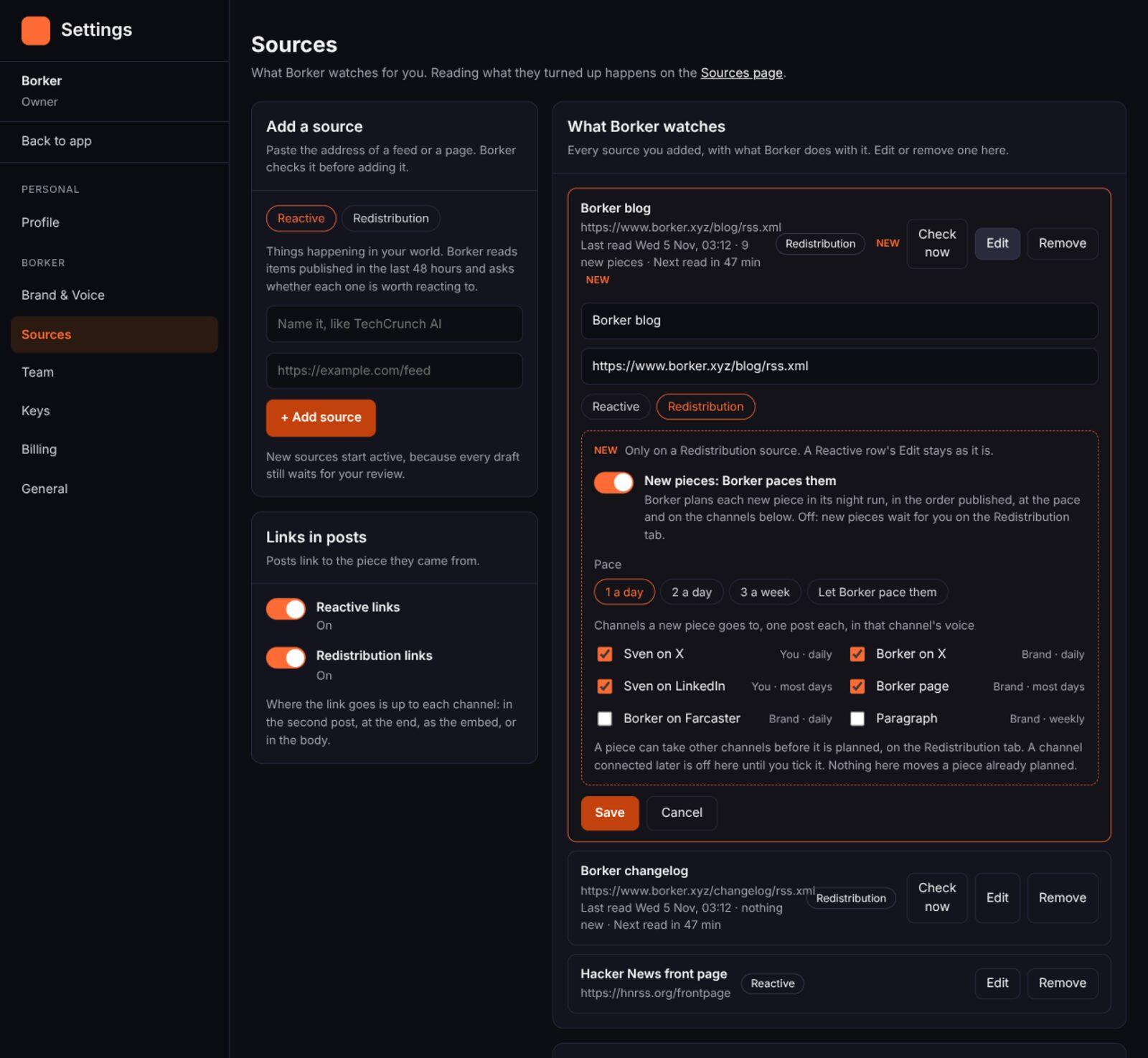
Each redistribution source carries its own defaults, and they answer the three questions that used to be the second job:
- Who plans a new piece. With "New pieces: Borker paces them" on, every piece the feed turns up is planned in the night run, in the order it was published. Off, new pieces wait for you on the Sources page until you plan them yourself.
- How fast. One a day, two a day, three a week, or let Borker pace them around whatever else is on the calendar.
- Where. The channels a new piece goes to, one post each, in that channel's voice. The main channels of both voices start on. A channel you connect later stays off until you tick it.
The row also says when the feed was last read and when the next read is, and Check now reads it at once. Nothing you change here moves a piece that is already planned, and the next piece you publish picks up the defaults the moment it lands in the feed. Including this one.
One piece a day, in the order they were published
This is the part that keeps nine pieces from being nine links in one afternoon.
The Sources page has a Redistribution tab: every piece Borker read from your feeds, and what it did with each one. Not yet planned, planned, shared, skipped. The nine parts of the series showed up there the morning after they went live, nine new, none planned yet.
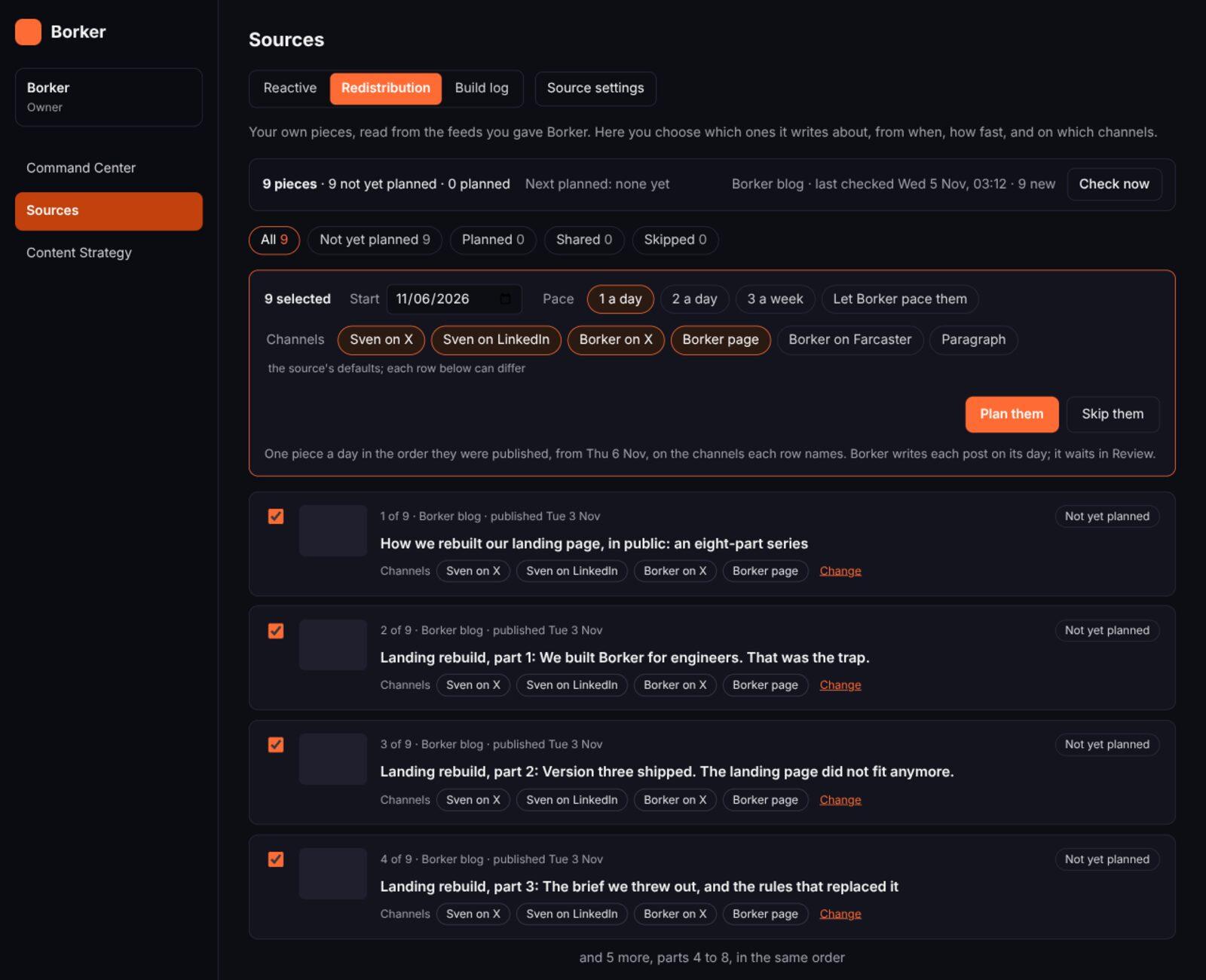
From here there are two ways to the same plan. Leave the source's switch on and the night run plans them: one a day, published order, the source's channels. Or tick the pieces yourself and use the plan bar: a start day, a pace for the batch, and the channels per piece, each row able to differ from the source's defaults. Plan them, or Skip them. Either way, Borker writes each post on its day, and the plan it compiles every night keeps the cadence of every channel while the queue drains. When the queue is empty, the calendar fills from your topics instead.
For the rebuild series that produced this:
| Day | Piece |
|---|---|
| Thu Nov 5 | The hub |
| Fri 6 | Part 1, the trap |
| Sat 7 | Part 2, the page did not fit |
| Sun 8 | Part 3, the brief |
| Mon 9 | Part 4, the story |
| Tue 10 | Part 5, no AI art |
| Wed 11 | Part 6, the kit and the wind |
| Thu 12 | Part 7, one act first |
| Fri 13 | Part 8, the build |
| Sat 14 | This piece |
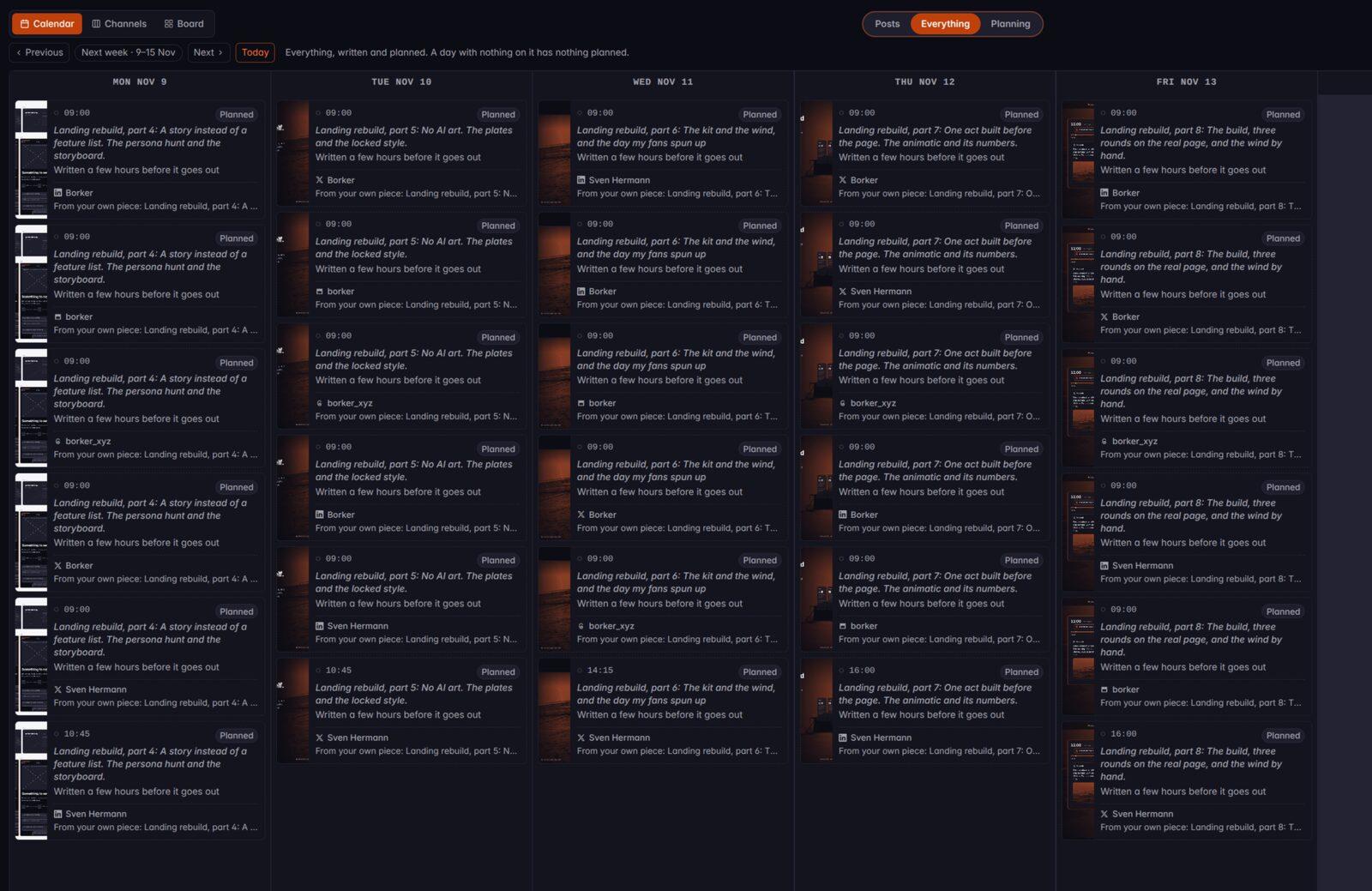
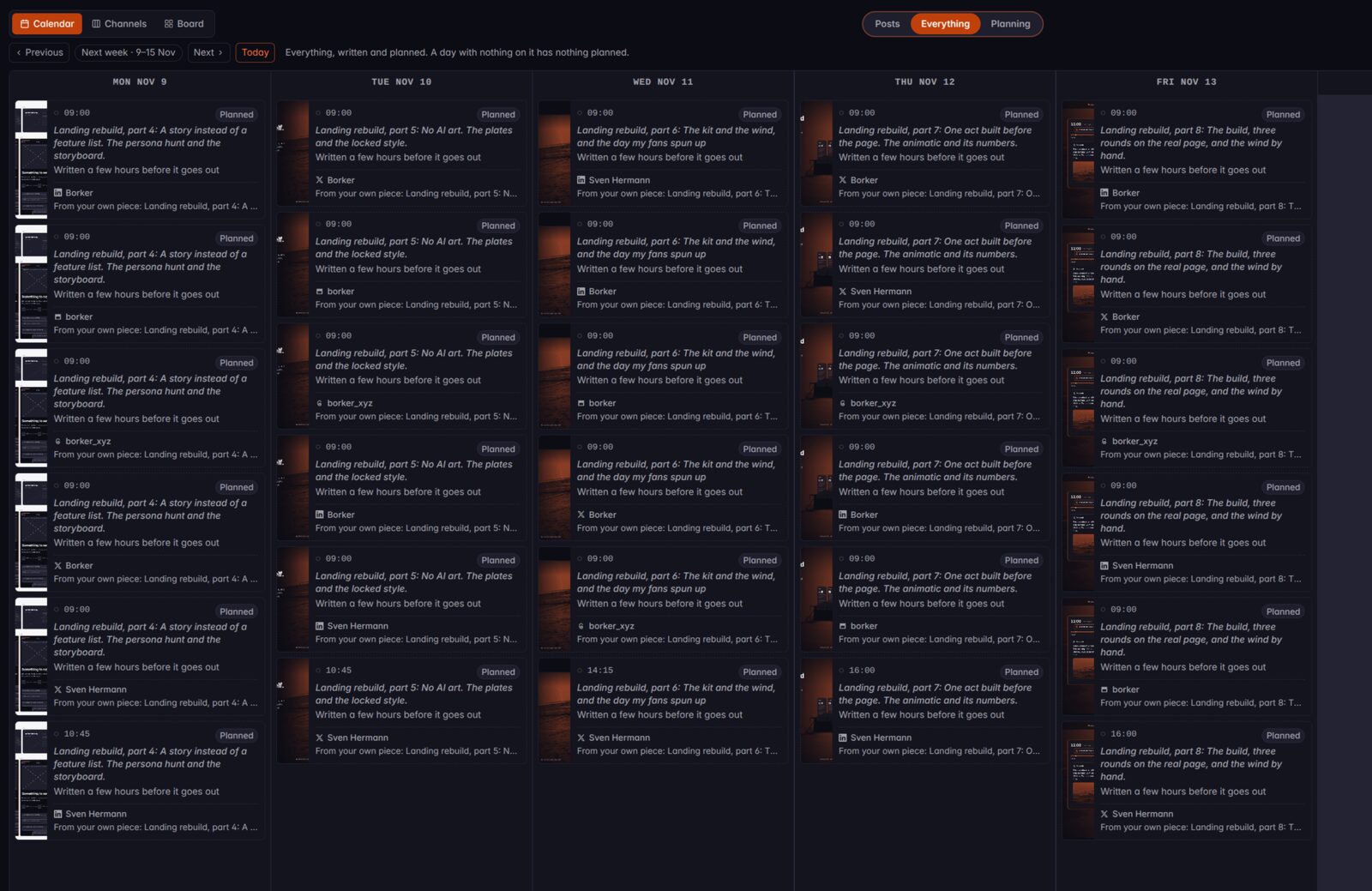
Ten days of presence from writing that was already done. The series came out in the order it was written, one part a day, and the piece you are reading took the first open day after part 8, because it arrived in the feed after the others. I did not pick the date. The queue did.
Each post is written on its day, in the channel's voice
Pacing solves when. The remaining work is what each post says, and that work is where the second job used to live.
Six channels carry the series: two X accounts, two LinkedIn surfaces, Farcaster and Threads. Four of them are the company's voice and two are mine. A LinkedIn post from me about part 3 is five paragraphs in the first person about the brief we threw away. The company's X post about the same part is two sentences. The Farcaster cast is lowercase. Each one is written a few hours before it goes out, from the piece itself, in the voice of the account it goes out from, and the link back to the piece is placed where that channel puts links: a second post in the thread on X, a line at the end on LinkedIn and Threads, the embed on Farcaster.
Here is the hub's day, as it went out:
| Channel | Voice | What went out |
|---|---|---|
| X, company | brand | "We rebuilt the Borker landing page from scratch and published every decision as it happened." Two sentences and the link. |
| LinkedIn, mine | personal | Six short paragraphs on why the rules came first and the rulings second, ending on who the series is for. |
| LinkedIn, page | brand | Four paragraphs on why a polished "finished product" post would have stripped out everything useful. |
| Threads, company | brand | One paragraph, the eight parts in order, "not the highlight reel version". |
None of those were typed by me. All of them were read by me, which brings me to the figure in the title.
The figure
| What | Count |
|---|---|
| Pieces written by hand | 9 |
| Channels | 6 |
| Days | 9 |
| Channel posts planned | 54 |
| Channel posts written by hand | 0 |
Fifty-four is the plan for the series through Friday the 13th: six channels, nine days. This piece adds its own day on top. The count comes from the plan Borker compiled, not from a promise, and if you are reading this on the 14th you can check it against the accounts.
Write once, and let it travel
What changed for me is not the amount of writing. It is what happens after. The series took the same effort it would have taken anyway, and the effort now has a second life that I did not have to schedule, caption, or remember.
That is the whole idea behind redistribution in Borker. Your blog, your changelog, your newsletter, anything you already publish with a feed, becomes a source. Every new piece is read, judged against your strategy, and paced into the plan on the first open day, one piece a day. Each channel gets its own post, in the voice of that account, with the piece's picture and the link placed where that channel wants it. The plan compiles itself every night, the posts are written on their day, and when the queue runs dry the calendar fills from your topics until the next piece lands.
The order of work turns around. You write the piece because it is worth writing, and the presence follows from it. One long thing becomes a week on every channel. A series becomes a month. The next thing you publish joins the queue the moment it is live, and the same happens again.
This piece went into the same feed as the other nine. If it reached you on a channel, that is the loop closing on itself. Connect your own feed under Settings, Sources, and the next thing you write does the same.
New here? Borker is the AI content engine for founders.
We learn your voice, read your sources, plan your week and write each post before it goes out, while you build the actual product.