Landing rebuild, part 5: No AI art. The plates and the locked style.
By the Borker Team
Part 5 of eight on rebuilding our landing page. Part 4 is the story and the storyboard. The hub lists every part.
The rule
One rule for the design: no graphics drawn or generated by agents in the final product.
The reason is the headline. A page that says "Not like AI" under a picture a model painted is arguing with itself, and the visitor we want is exactly the one who can tell. The same goes for a synthetic voiceover, a stock avatar, an invented quote. Everything on the page has to be either a real thing or plainly type and lines.
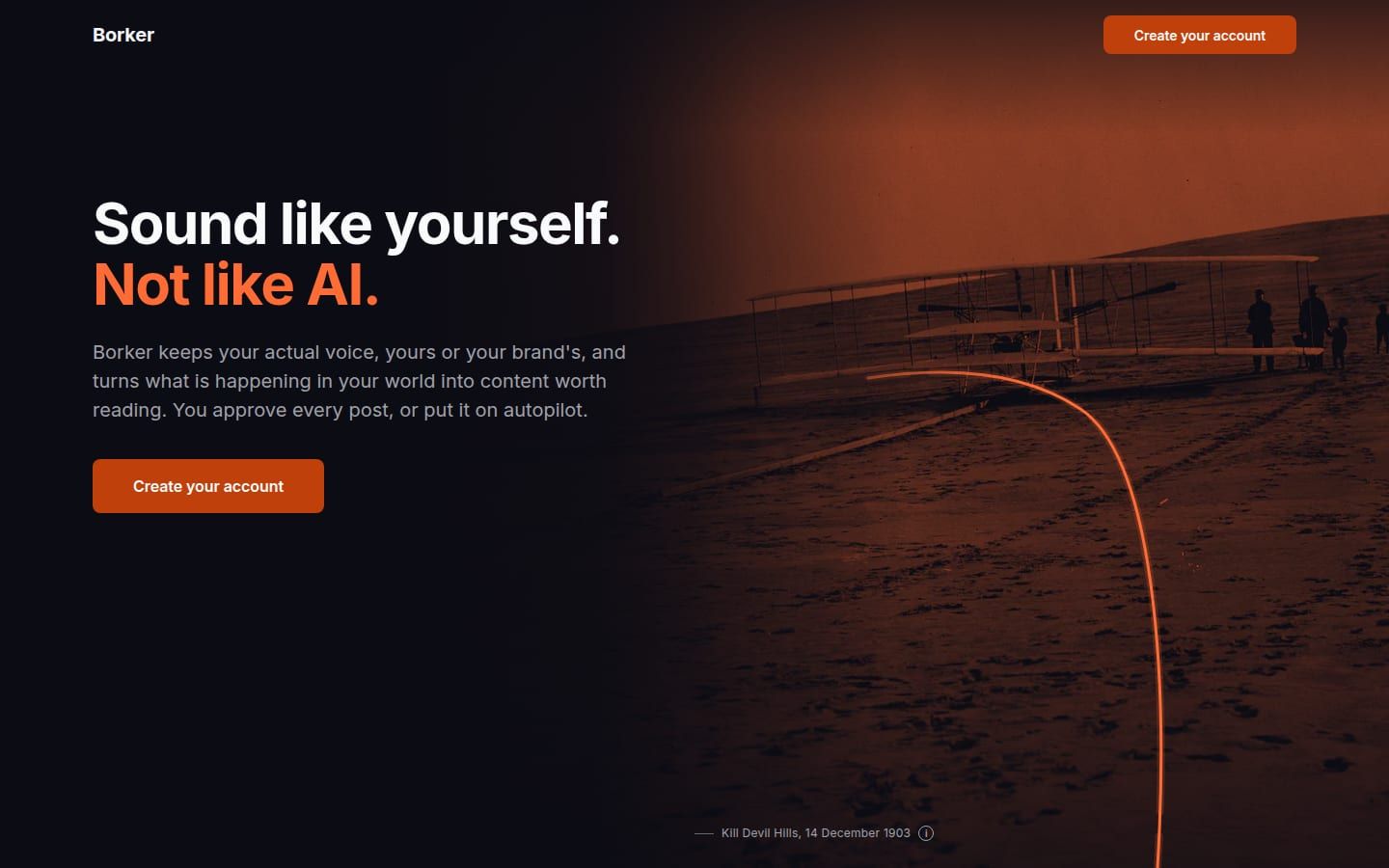
So the backgrounds are photographs the Wright brothers took themselves. The Library of Congress holds their glass-plate negatives, and the records say "No known restrictions." Everything else on the page is type, lines and the brand's two oranges. A script treats the plates; a person picks them; nothing is painted.
Generated images are allowed under one condition: each one needs my approval per prompt, with the prompt, the model and the cost listed. Through the whole design that count stayed at zero.
The plates
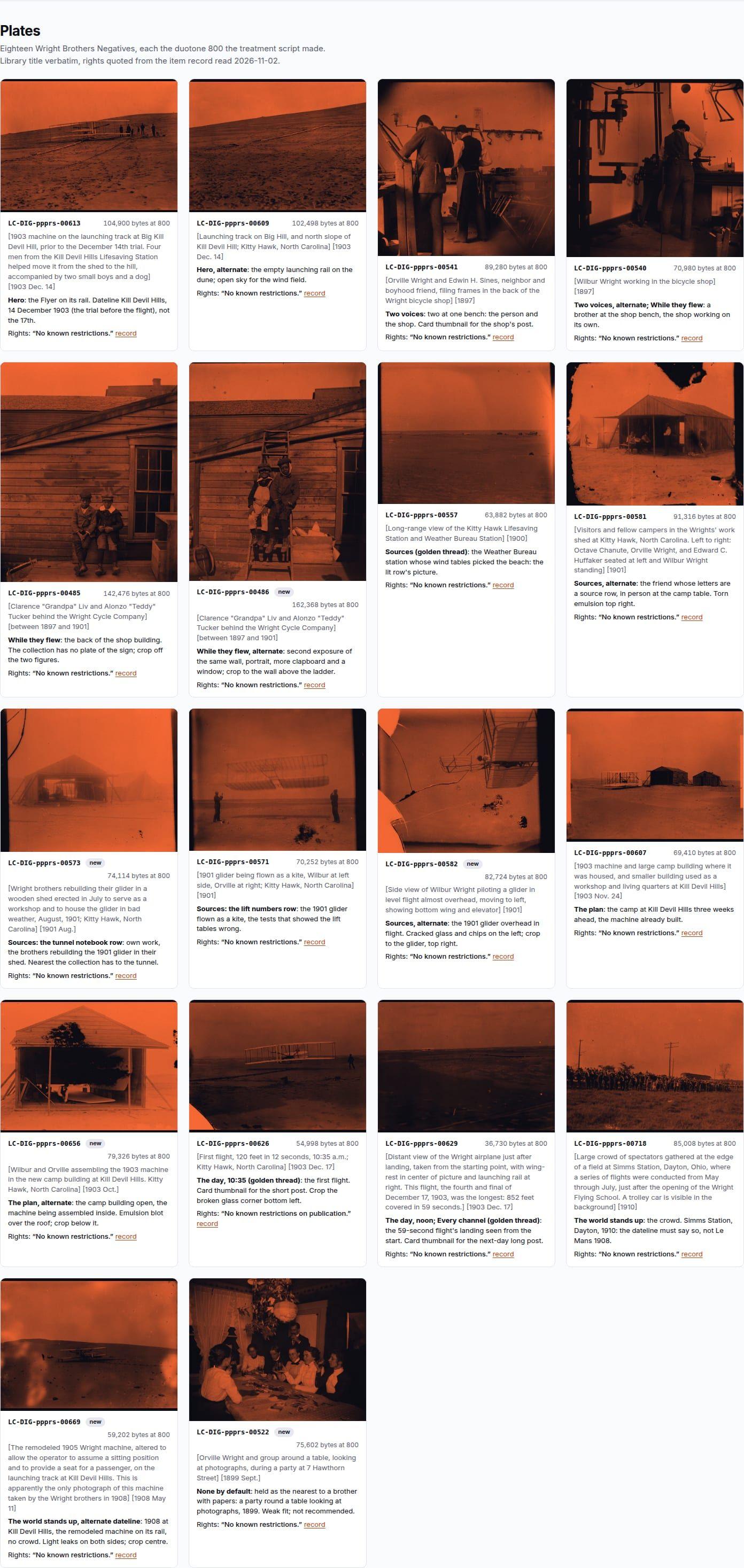
Eighteen plates, each with its library title verbatim and the rights statement read from its record. Every picture the landing uses comes from this table.
| Plate | Library title | Date | Rights | Where it serves |
|---|---|---|---|---|
| LC-DIG-ppprs-00613 | 1903 machine on the launching track at Big Kill Devil Hill, prior to the December 14th trial. Four men from the Kill Devil Hills Lifesaving Station helped move it from the shed to the hill, accompanied by two small boys and a dog | 1903 Dec. 14 | No known restrictions. | The hero. Dateline Kill Devil Hills, 14 December 1903, the trial before the flight |
| LC-DIG-ppprs-00609 | Launching track on Big Hill, and north slope of Kill Devil Hill; Kitty Hawk, North Carolina | 1903 Dec. 14 | No known restrictions. | Hero, alternate: open sky for the wind |
| LC-DIG-ppprs-00541 | Orville Wright and Edwin H. Sines, neighbor and boyhood friend, filing frames in the back of the Wright bicycle shop | 1897 | No known restrictions. | Two voices: two at one bench, the person and the shop |
| LC-DIG-ppprs-00540 | Wilbur Wright working in the bicycle shop | 1897 | No known restrictions. | While they flew: the shop working on its own |
| LC-DIG-ppprs-00485 | Clarence "Grandpa" Liv and Alonzo "Teddy" Tucker behind the Wright Cycle Company | between 1897 and 1901 | No known restrictions. | While they flew: the back of the shop |
| LC-DIG-ppprs-00486 | Clarence "Grandpa" Liv and Alonzo "Teddy" Tucker behind the Wright Cycle Company | between 1897 and 1901 | No known restrictions. | While they flew, alternate |
| LC-DIG-ppprs-00557 | Long-range view of the Kitty Hawk Lifesaving Station and Weather Bureau Station | 1900 | No known restrictions. | Sources: the station whose wind tables picked the beach |
| LC-DIG-ppprs-00581 | Visitors and fellow campers in the Wrights' work shed at Kitty Hawk, North Carolina. Left to right: Octave Chanute, Orville Wright, and Edward C. Huffaker seated at left and Wilbur Wright standing | 1901 | No known restrictions. | Sources, alternate: the friend whose letters are a row |
| LC-DIG-ppprs-00573 | Wright brothers rebuilding their glider in a wooden shed erected in July to serve as a workshop and to house the glider in bad weather, August, 1901; Kitty Hawk, North Carolina | 1901 Aug. | No known restrictions. | Sources: the notebook row, their own work |
| LC-DIG-ppprs-00571 | 1901 glider being flown as a kite, Wilbur at left side, Orville at right; Kitty Hawk, North Carolina | 1901 | No known restrictions. | Sources: the lift numbers row |
| LC-DIG-ppprs-00582 | Side view of Wilbur Wright piloting a glider in level flight almost overhead, moving to left, showing bottom wing and elevator | 1901 | No known restrictions. | Sources, alternate |
| LC-DIG-ppprs-00607 | 1903 machine and large camp building where it was housed, and smaller building used as a workshop and living quarters at Kill Devil Hills | 1903 Nov. 24 | No known restrictions. | The plan: the camp three weeks ahead, the machine already built |
| LC-DIG-ppprs-00656 | Wilbur and Orville assembling the 1903 machine in the new camp building at Kill Devil Hills. Kitty Hawk, North Carolina | 1903 Oct. | No known restrictions. | The plan, alternate |
| LC-DIG-ppprs-00626 | First flight, 120 feet in 12 seconds, 10:35 a.m.; Kitty Hawk, North Carolina | 1903 Dec. 17 | No known restrictions on publication. | The day, 10:35. The short post's picture |
| LC-DIG-ppprs-00629 | Distant view of the Wright airplane just after landing, taken from the starting point, with wing-rest in center of picture and launching rail at right. This flight, the fourth and final of December 17, 1903, was the longest: 852 feet covered in 59 seconds. | 1903 Dec. 17 | No known restrictions. | The day, noon. The long post's picture |
| LC-DIG-ppprs-00718 | Large crowd of spectators gathered at the edge of a field at Simms Station, Dayton, Ohio, where a series of flights were conducted from May through July, just after the opening of the Wright Flying School. A trolley car is visible in the background | 1910 | No known restrictions. | The world stands up: the crowd, with its honest dateline |
| LC-DIG-ppprs-00669 | The remodeled 1905 Wright machine, altered to allow the operator to assume a sitting position and to provide a seat for a passenger, on the launching track at Kill Devil Hills. This is apparently the only photograph of this machine taken by the Wright brothers in 1908 | 1908 May 11 | No known restrictions. | The world, alternate dateline |
| LC-DIG-ppprs-00522 | Orville Wright and group around a table, looking at photographs, during a party at 7 Hawthorn Street | 1899 Sept. | No known restrictions. | Held in reserve, not recommended |
Credit line: Library of Congress, Prints and Photographs Division, Wright Brothers Negatives, with the reproduction number. The Library's own statement, which every record carries, says it does not own rights to the material and that the obligation to assess restrictions sits with whoever publishes. We read every record on the day. A lawyer's read of the page is on the polish list.
What the collection does not have is as useful to know as what it has. There is no plate of:
- the shop's sign
- a brother at a desk with papers
- the wind tunnel, the notebook, the telegram, a letter or the newspaper
And the only crowd is at Simms Station, Dayton, in 1910, not Le Mans in 1908. Each gap got a typeset card instead.
The crowd beat uses the Dayton plate and says Dayton, 1910, on its dateline. No plate was faked and no dateline lies.
The treatment
One script, run from the repo, makes every variant from the raw master:
- Trim 4.5 percent per side.
- Greyscale.
- Stretch the first to the ninety-ninth percentile.
- Gamma 1.3.
- Map black to the page's night and white to the brand orange.
- Seeded grain.
A soft variant fades the plate radially into the ground where it has to recede. A line variant extracts the strongest edges for one of the three directions below. Each plate ships at 1600, 800 and 400 wide as WebP, with a byte budget per file, and the script re-treats one plate or all of them with one command, byte-identical on rerun.
Three directions
Stage two finished two beats, the hero and the sources-into-plan transition, in three directions at both widths. Each direction came with its own sheet.

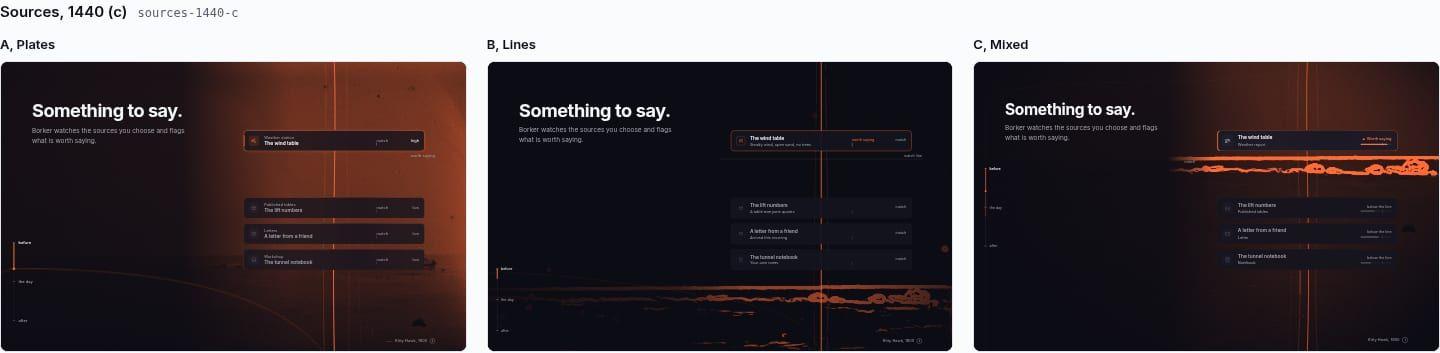
A, Plates. The photograph is the mood; the card is the product. A plate in the orange duotone fills the frame, low key, and frosted cards sit in front of it.
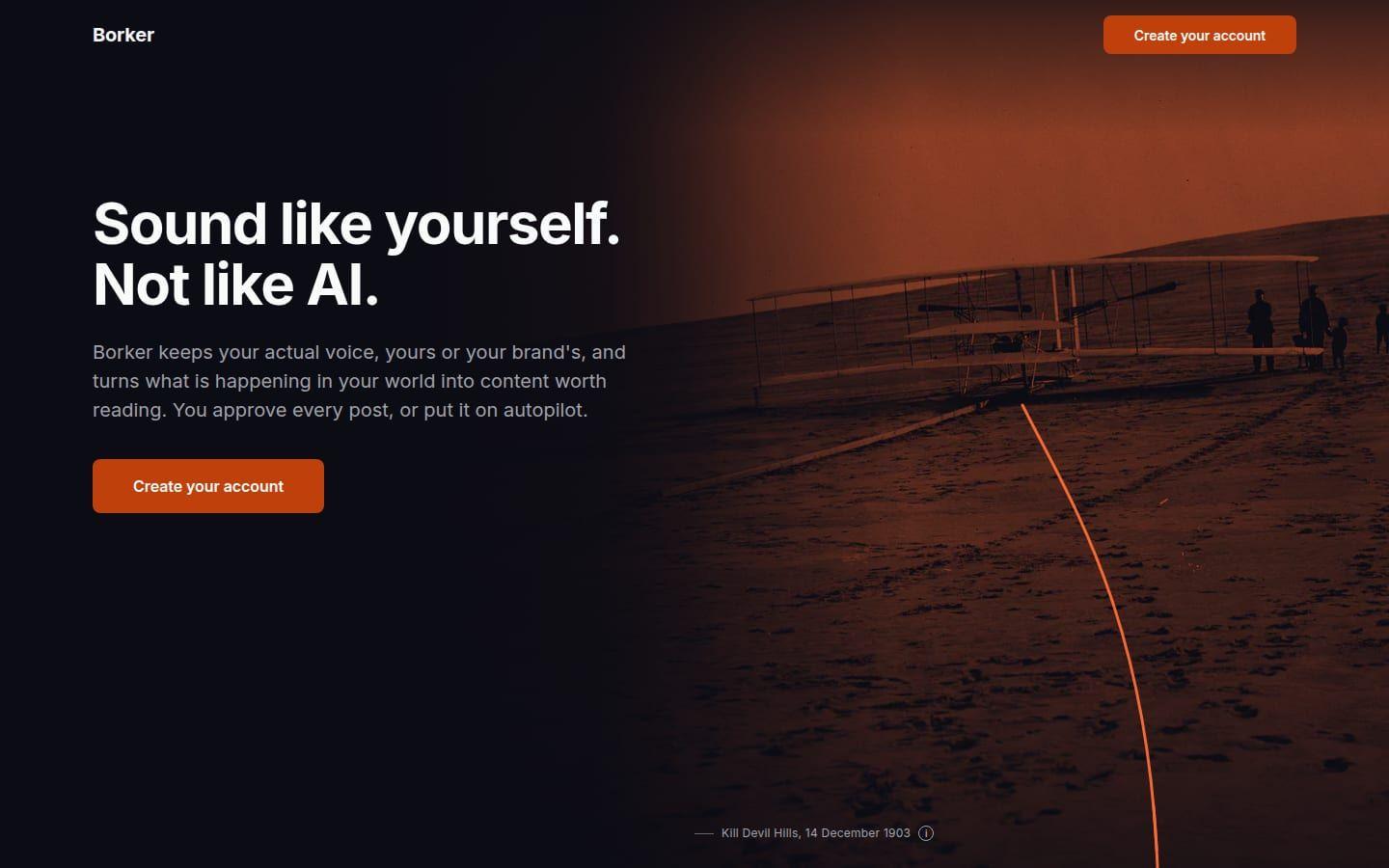
B, Lines. One drawing system. The 1903 layer is the plate's own edges, extracted by script and laid on the dark ground as orange line. Cards, wind and rail are drawn in the same hairline weight, and the photograph, the product and the thread read as one diagram.

C, Mixed. The faded photograph plus the line, where the line becomes part of the interface: on Sources, the plate's horizon is the match line, and the lit row rises above the real horizon of Kitty Hawk.

The ruling
My first reaction to the board: too many variables per row. Three directions, two wind treatments, a rail on or off, two widths. A board that asks six questions per row cannot be answered in a few sentences, and the rule says it must be. The second version asked one question per row.
What was ruled, and why:
- Backgrounds are always the treated photograph. The edge-extracted look reads as a filter at hero scale, and the dark page without a photograph stops feeling like a place.
- "Not like AI." is orange. The only orange words on the page. Orange is otherwise an edge, a spine, a fill, never text.
- The wind is drawn and drifts the way B did it. But no line may enter the frame from the left edge, and nothing is emitted from a rail into the content. The wind starts at the machine and flows down through the page.
- The example posts are readable. The rule from the storyboard, held here: if the page says Borker writes in your voice, you need to be able to read what it wrote.
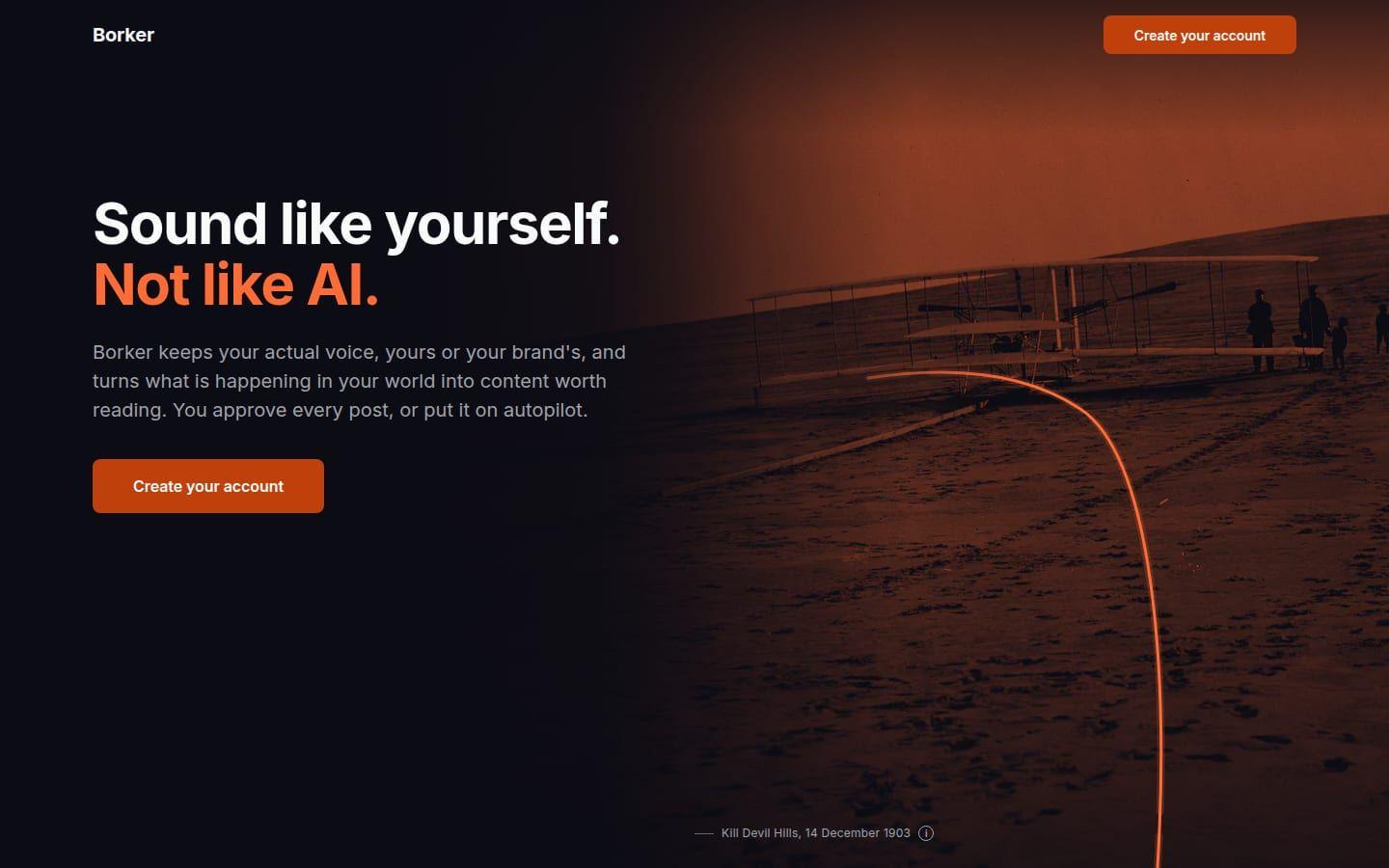
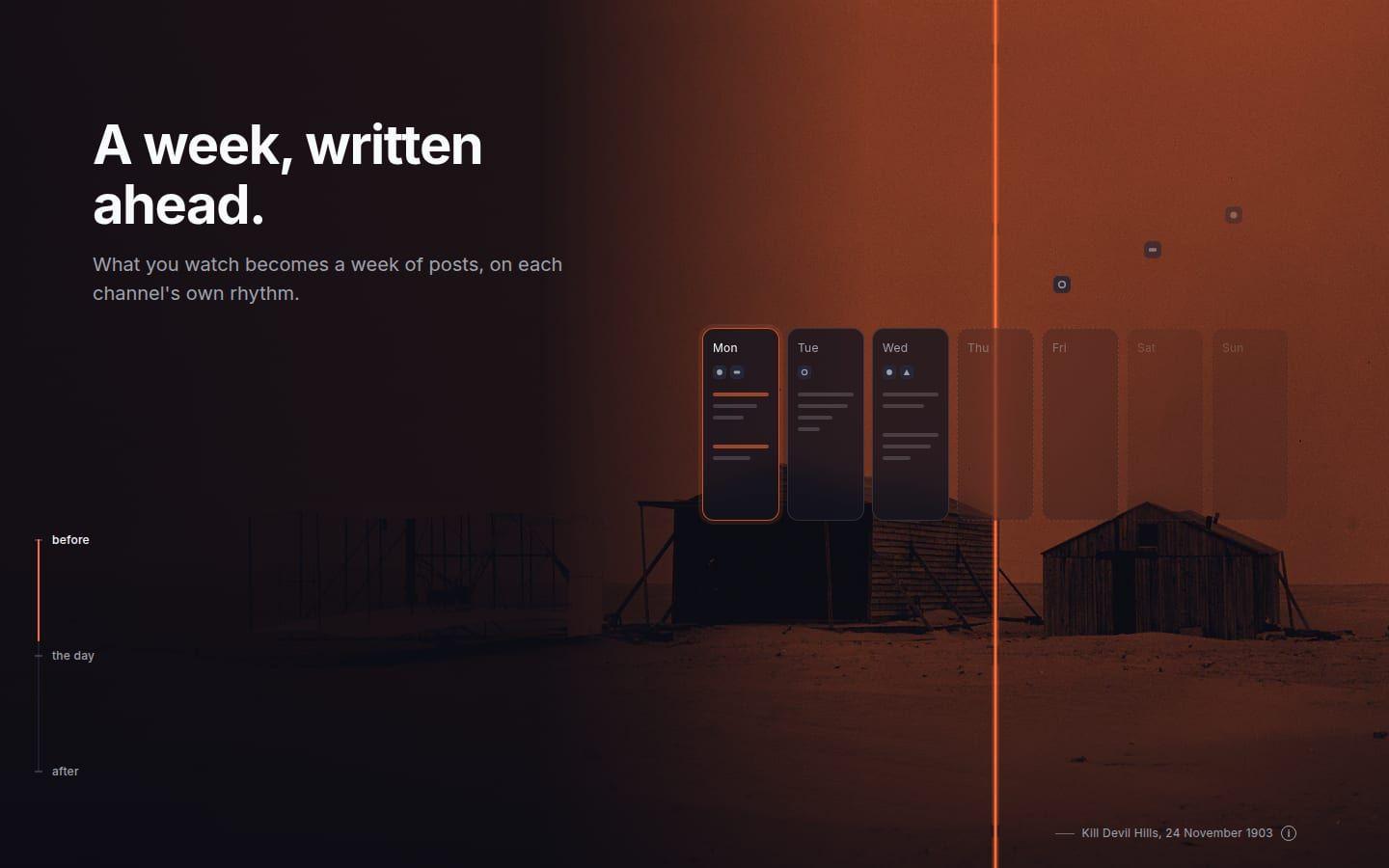
The style sheet that came out of it is short. The dark palette of the app, nothing added except one alias for the words on a dim row. Glass cards at 78 percent over the plate, with a one-pixel edge. A dim row goes near solid, because a measurement on the rendered frames showed the words on a dim row over a plate failing contrast, and the fix was measured again before it was written down. Inter, with the same feature settings the app uses. One type scale per width.
Two things were still open on that board, the wind as a single line or a band, and whether the act rail shows. Both were settled the same evening by a bigger change, and that is part 6.
The series: hub · part 1 · part 2 · part 3 · part 4 · part 5 · part 6 · part 7 · part 8
New here? Borker is the AI content engine for founders.
We learn your voice, read your sources, plan your week and write each post before it goes out, while you build the actual product.