Landing rebuild, part 4: A story instead of a feature list. The persona hunt and the storyboard.
By the Borker Team
Part 4 of eight on rebuilding our landing page. Part 3 is the brief that failed and the rules that replaced it. The hub lists every part.
One story, with a thread you feel
I wanted the page to tell one story instead of listing features, with a red thread running through it that you feel even if you never notice it. The idea that made it work: the transitions carry the concept. When one beat transforms into the next, the transformation says what Borker does, more than any sentence on the beat could.
Every beat has two layers. Behind, a scene from the story. In front, a stylised Borker surface that would have done the job in that scene: a voice card, a source row, the week, a post. You read the story in the picture and the product in the card, and the card is suggested, never a screenshot.
The story needs a person. Or two.
The persona hunt
The rule for the persona: a device to illustrate the point, nothing more. What it had to have:
We went through a long list.
| Candidate | Why not |
|---|---|
| Benjamin Franklin | A political figure |
| Amelia Earhart | No happy ending, and a licensed likeness |
| Cleopatra | Politics, the ending, and a contested record |
| Steve Jobs | Right of publicity, and a company's marks |
| Henry Ford | Politics |
| Alexander Graham Bell | Marks, and a eugenics history |
| Karl Benz | A live mark |
| Nikola Tesla | The name is overused |
| Gutenberg, Leonardo, Ada Lovelace, Van Gogh, Dickens | All fine, not chosen. Dickens is the alternate |
The Wright brothers fit on every count.
- Two people with their own voice.
- A brand with its own voice: the Wright Cycle Company, whose bicycles sold under the Van Cleve name, and which kept running in Dayton while the brothers were on the dunes.
- Sources they watched:
- the Weather Bureau's wind tables, which picked the beach
- Lilienthal's lift tables, which turned out wrong
- Chanute's letters
- their own wind tunnel notebook
- A day where everything happened at once, December 17, 1903: four flights, the first at 10:35 for twelve seconds, the last at noon for fifty-nine seconds and 852 feet.
- A telegram home that evening, which the operator garbled to "57 seconds" and which asked the family to inform the press.
- A hometown paper that passed, and another paper that ran a story about three miles over the ocean.
- Then five years of nobody believing them, and a field at Le Mans in August 1908 where the world stood up.
Every piece of that maps onto something Borker does. The shop running while they flew is the one I care about most: you build, Borker writes about it, and the final say stays yours. And the photographs are public domain.
The storyline
Eleven beats, in one continuous motion. The headline and the line of each beat are the only words on it.
| Beat | What transforms | What it says about Borker | Headline |
|---|---|---|---|
| Hero | The machine on its rail in a 21-mile wind; the wind starts | The promise | Sound like yourself. Not like AI. |
| Two voices | Two voices settle into two voice cards, with the topics beside them | One workspace, two voices, the channel decides | Your voice. Both of them. |
| Sources | Four source rows slide in on the wind: the wind table, the lift numbers, a letter from a friend, the tunnel notebook. One crosses the line and lights | Borker watches your world and knows what is worth it | Something to say. |
| The plan | The rows turn and tile into a week; the flight day stays open | What you watch becomes a week, written ahead | A week ahead, filled as it happens. |
| The day | A time strip runs 10:35 to noon; wires arrive; one becomes a post, one sits below the line, garbled | Same-day reactions, and the judgment that keeps the wrong one out | The same day. |
| Every channel | The post fans into four cards, each in its channel's shape | One thing happened, four posts, each native | One thing happened. Four posts. |
| While they flew | The cards travel out and go; one waits at the gate with its reason, then is approved | Autopilot with the gates, the final say still yours | It runs while you build. |
| The world stands up | The sent cards tile outward until they are the crowd | What went out, week after week | (one line only) |
| Recap | Static | What comes in, what Borker writes, what goes out | What comes in. What Borker writes. What goes out. |
| Is Borker for you | Static, for and not for, the channels as icons | Is Borker for you? | |
| Plans, then the close | Static | Sound like yourself. Start with a real week. |
On a phone the picture sits above the card instead of behind it, and the first screen is the hook, the subhead, the button and the machine.
The storyboard
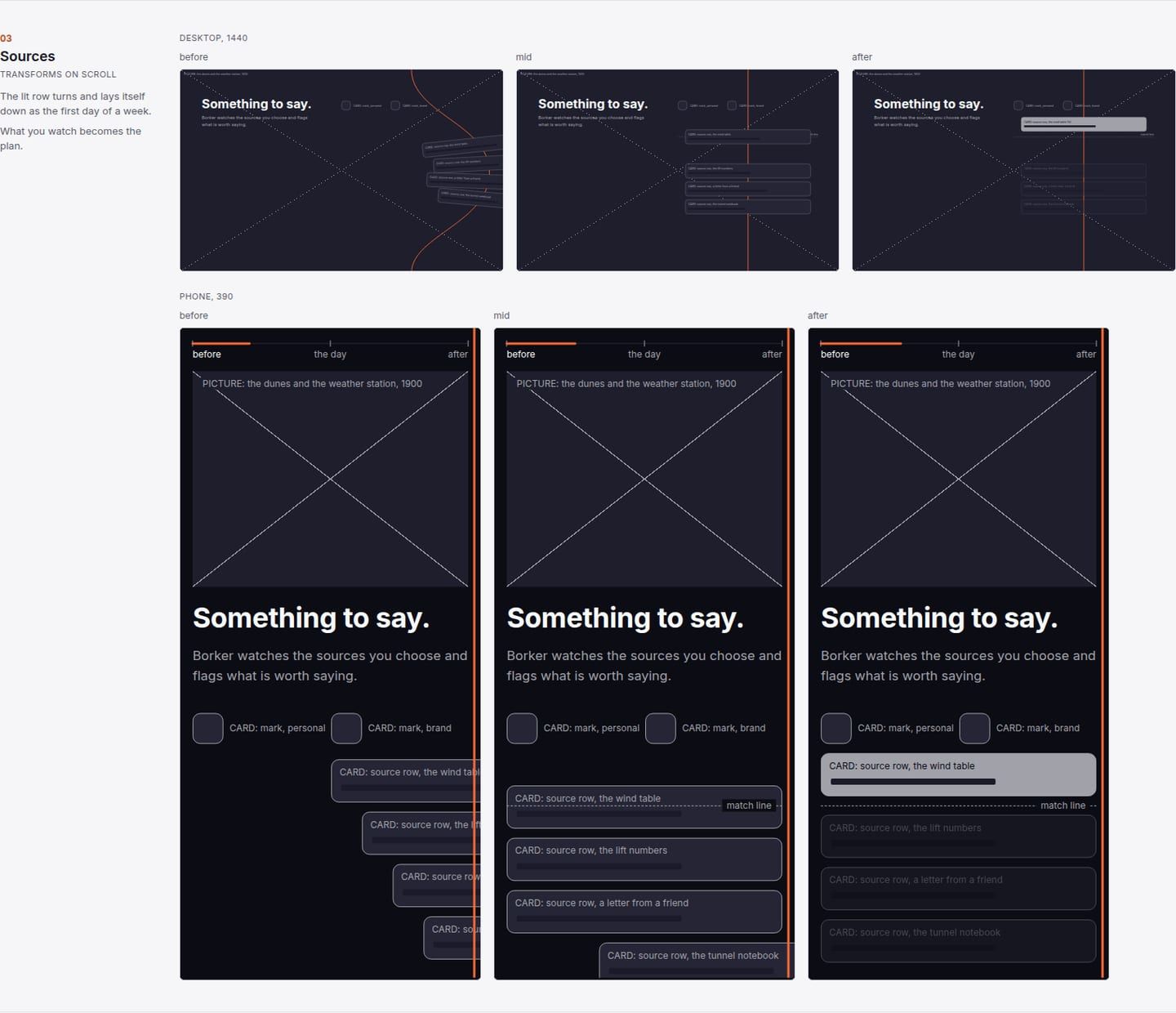
Stage one was the storyboard. Every beat as key frames, three per transforming beat (before, mid, after), at 1440 and 390 side by side. Grey boxes in real proportions, real copy, one orange line for the wind, and nothing else. No style, no photographs, no motion code. Composition and text get decided here, with nothing else to argue about.
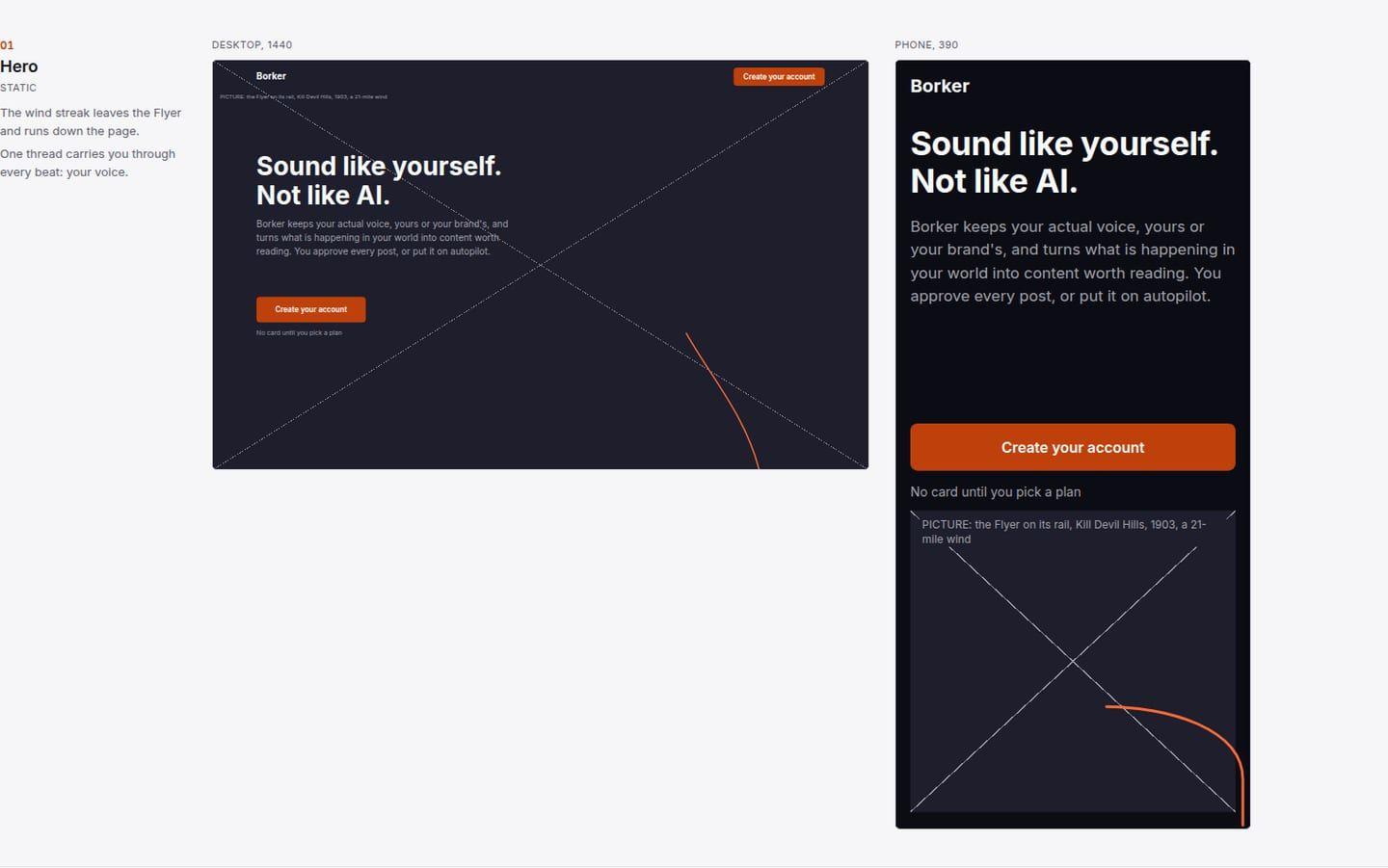
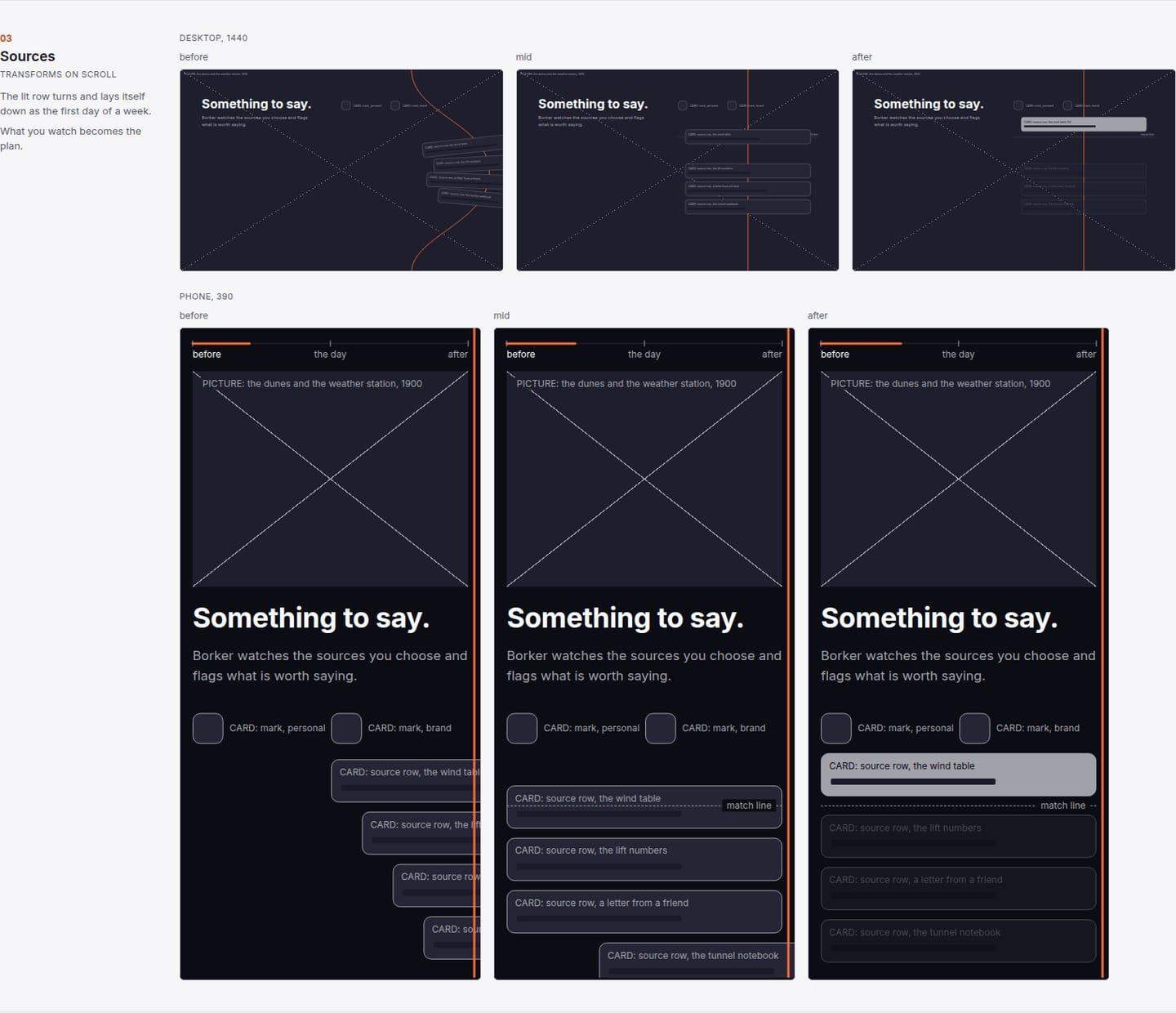
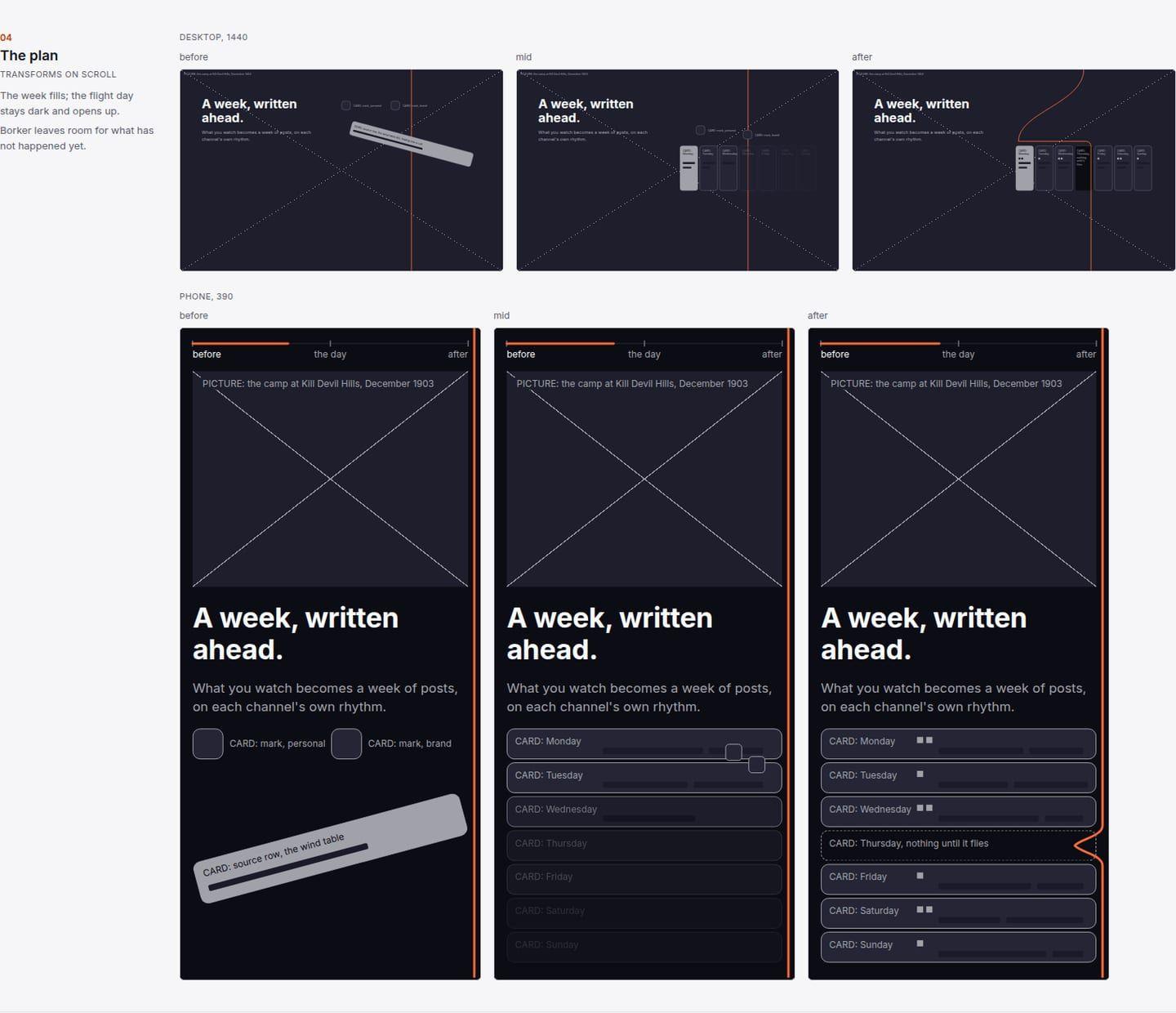
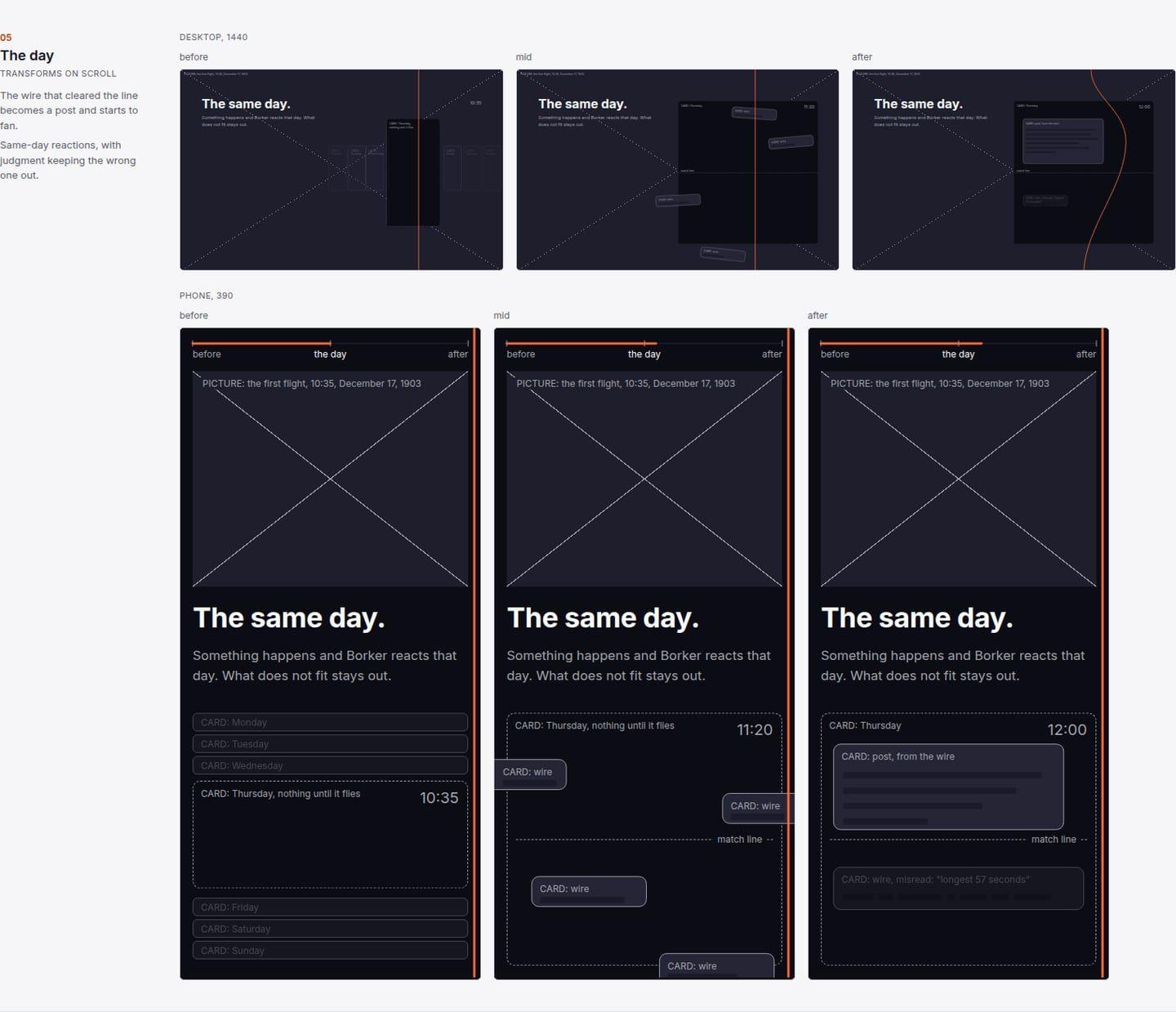
The board had a vocabulary of five elements (picture, card, text, button, streak) and a text budget per frame that the checker counted: one headline of six words or fewer, one line of fourteen or fewer. A beat that needed more was redrawn or cut. In the end the board held eleven beats and forty-six story frames, plus a strip of seventeen candidate sections (a logo strip, a testimonials block, big numbers, a founder note), each drawn once so I could point at what to add. Most stayed off: the ones that need proof we do not have yet wait for the proof.
My read of the board took a few sentences. Composition good. Text amount good. Order and length good. The changes were small and specific:
- the hero loses its friction note
- on the phone the picture sits behind the hero text, fading
- the "while they flew" headline carries the beat and the held card carries the final say
- a recap beat after the crowd, cuttable if the page runs long
The rule the board exposed
One thing was wrong with the storyboard that no frame showed. The page never showed what Borker wrote. Every post on it was a stylised card with grey bars for text. If the headline says Borker writes in your voice, you have to be able to read what it wrote.
So one source now carries through the whole page.
| Beat | The wind table |
|---|---|
| Sources | crosses the line |
| The plan | fills Thursday |
| The day | lands as the wire |
| Every channel | is readable, in both voices, with a small picture in the card |
Two or three readable posts on the page. Every other card stays stylised.
The three posts, as approved:
- Personal, short, the day it flew: "Three weeks of wind tables said wait. This morning: 21 miles an hour, steady. We flew. Twelve seconds, then fifty-nine."
- Brand, the shop's page: "The Wright Cycle Company closes early Thursday. The brothers are at Kill Devil Hills, and the wind is right."
- Personal, long, the next day: "The paper says three miles over the ocean. It was 852 feet over sand, and it was enough."
The two voices beat also gained the strategy: four topic chips beside the voice cards (flight, wind, the shop, the bicycles), and each source row shows the chip it matched. The tunnel notebook ranks first, because it is their own work, which is how Borker ranks yours.
Next, the look, and the rule against AI art. That is part 5.
The series: hub · part 1 · part 2 · part 3 · part 4 · part 5 · part 6 · part 7 · part 8
New here? Borker is the AI content engine for founders.
We learn your voice, read your sources, plan your week and write each post before it goes out, while you build the actual product.