Brand & Voice
Tell Borker what it may say about you and your brand, and how each of you sounds. Every post then reads as written by the right one.
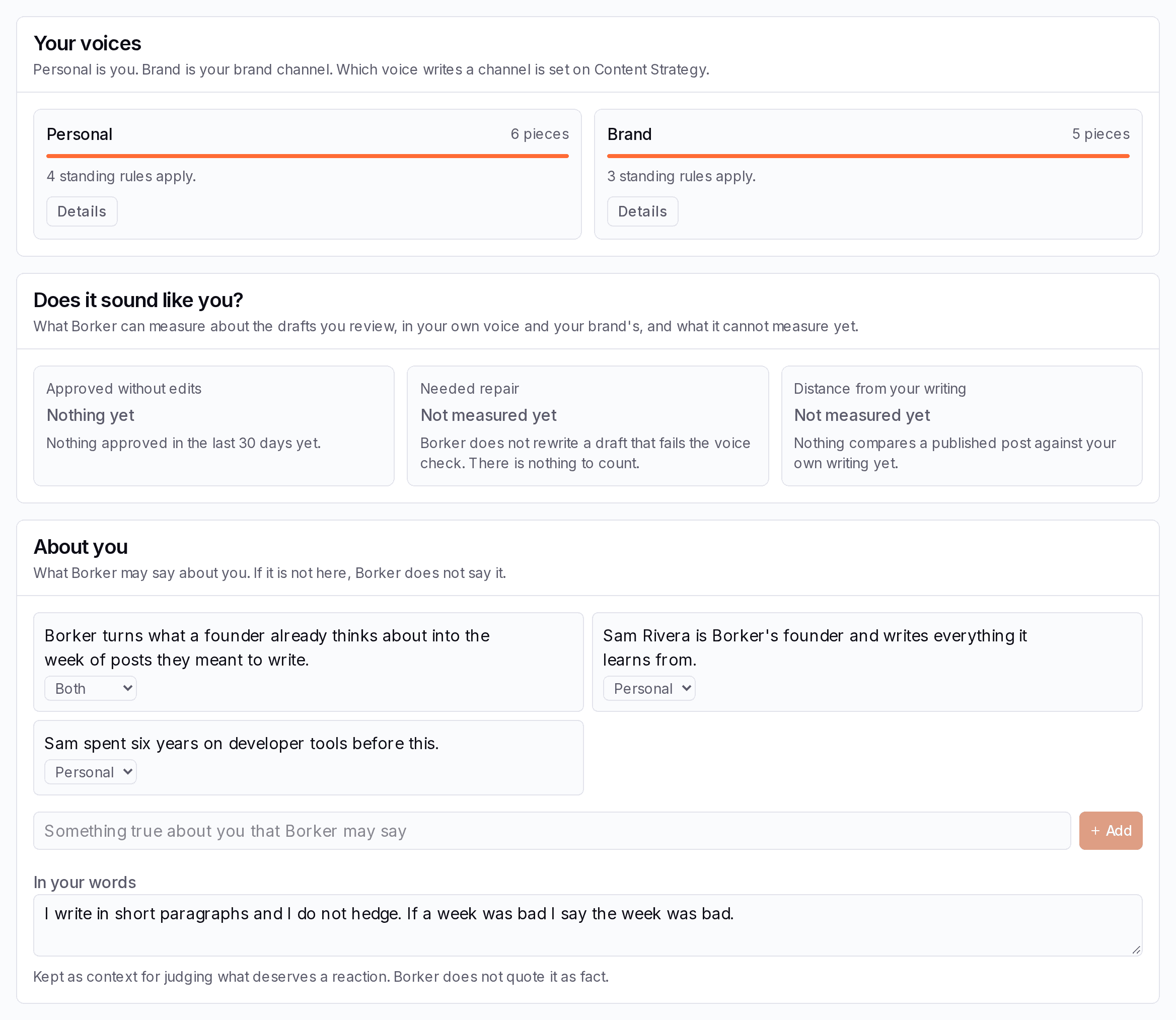
Your workspace has two voices: Personal, which is you, and Brand, which is your brand. Every channel speaks in one of them, and a post is written in the voice of the channel it goes to. You choose each channel's voice on Content Strategy, under Voice on its card.
Two voices
Every channel speaks in one. Each has its own facts, writing and rules.
Anything set to Both counts for each voice.
Anything set to Both counts for each voice.
Everything else about the voices lives in Settings → Brand & Voice. Admins and owners make changes there. Editors can read it.
| Section | What it holds |
|---|---|
| Your voices | One card per voice, with what Borker has to go on |
| Does it sound like you? | How the drafts you review are landing, for you and your brand |
| About you, About your brand | The only facts Borker may state |
| Your writing | Writing you paste in, yours and your brand's |
| Standing rules | How you and your brand sound, on any subject |
| Allowed exceptions | Phrases the voice check lets through |
Your voices
Open a voice card to see What Borker observed, the writing it holds in that voice, and What you told it, the rules that voice follows. Add a rule on a card starts a rule for that voice.
About you and About your brand
These boxes are the only source of claims Borker makes. If a fact is not written here, Borker does not state it: no capability, no history, no customer, no number.
- Name and Link (About your brand): your brand name, and the exact link Borker uses when it points at your brand. Borker never guesses a domain.
- Facts: one line each, set to Personal, Brand or Both. Write what you would want a stranger to repeat. "An AI content engine for technical founders posting on X and LinkedIn" beats "A content platform."
- In your words and In your brand's words: one paragraph per voice. Borker uses it to judge what is worth reacting to, never as a fact to state.
If Borker ever writes something untrue, the fix is here: add the correct fact, or remove the one it drew on.
Your writing
Press Add your writing, paste something you or your brand wrote, pick Personal, Brand or Both, and press Add this. Rough is fine. Unedited is better: that is what carries a voice.
Each voice is counted on its own. Once a voice has enough pieces, its drafts are written with a few of them in view. A brand post with no brand writing uses none rather than borrowing yours. The pieces shape how a draft sounds, never what it says: Borker does not reuse their facts, stories or links.
Until a voice has enough pieces, its card says so, and Borker keeps drafting from About you and your topics. Nothing is blocked.
Remove a piece that does not sound like you or your brand and Borker stops using it.
Standing rules
A rule is a short line, plus an optional note on why it exists and where the line is. Every draft follows the rules of the voice it is written in.
| Works | Does not work |
|---|---|
| "Never open with a question." | "Be engaging": too vague to follow |
| "Start with the most important point, not with context." | "Write well": means nothing |
| "Prefer: ship, iterate. Never use: leverage, delve." |
A new rule applies to Personal unless you pick Brand or Both. Remove a rule to stop it steering your drafts.
A rule about a subject, like "Never mention pricing", belongs under Avoid on Content Strategy, where every draft is checked against it. The rule box points you there.