We out-engineered ourselves. Why modern life feels like too much, and what to subtract
By the Borker Team
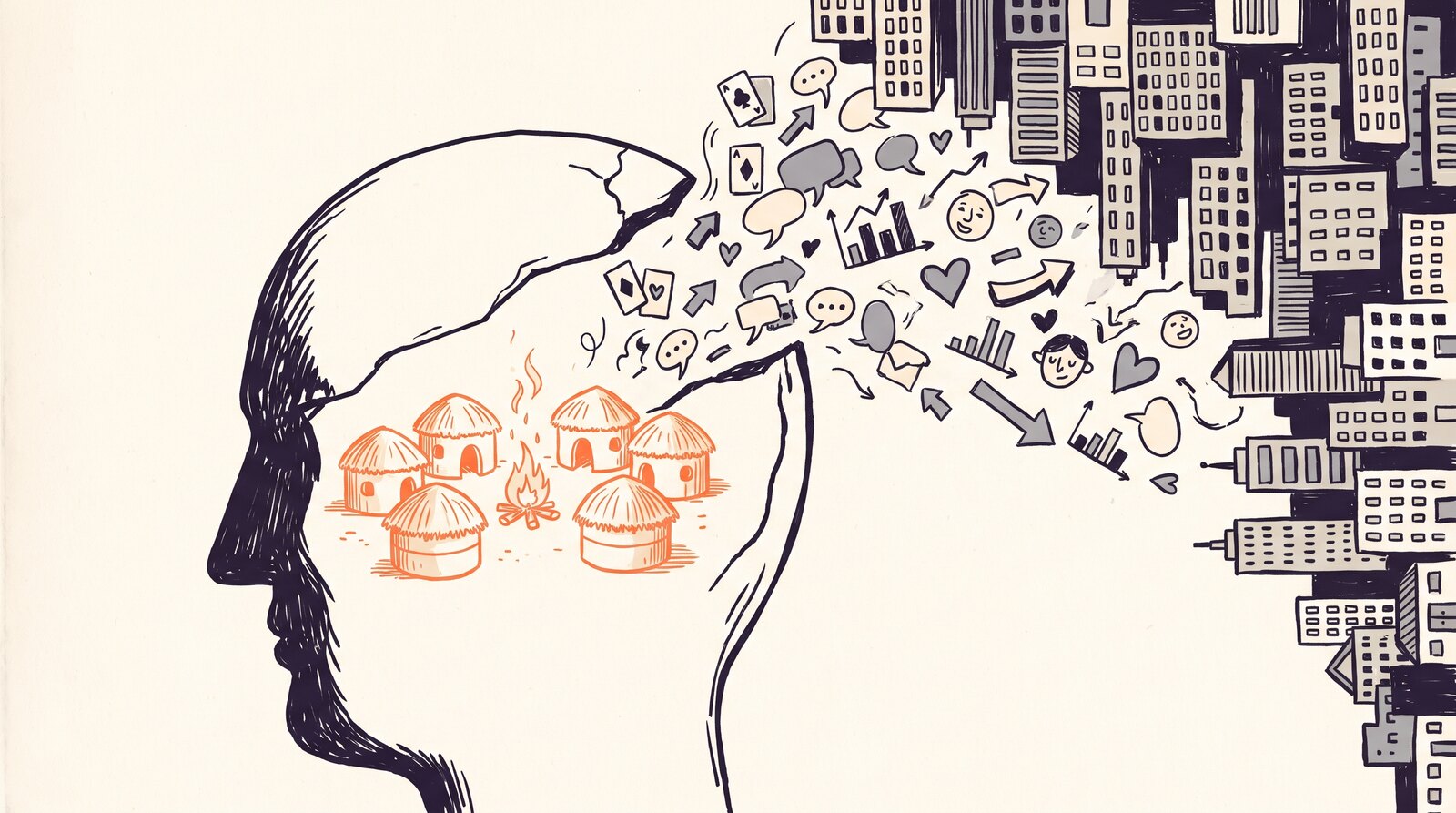
You wake up and the phone is already full. Three apps want a reaction before coffee. A founder you have never met raised a round. Someone's product launched, someone's company died, a war moved, a market moved. By the time you sit down to work, you have met more strangers' lives than your great-grandparents met in a year, and you have done nothing yet.
Then the second job: you are supposed to be out there too. Post something. Keep the account warm. Say a thing about the thing. The tab stays open all day, and the feeling that you should be performing somewhere never quite closes.
If that sounds like a personal failing, read on. The problem is hardware, and the hardware is you.
A village brain in a billion-person feed
In April a review in the journal Behavioral Sciences put a name on it. Jose Yong of James Cook University and Sarah Chan of the Singapore University of Technology and Design call it evolutionary mismatch: instincts shaped for one environment, forced to operate in a very different one. The human brain, they write, evolved for "a world of familiar faces, immediate threats and small social groups." That brain now reads an endless stream of curated lives, achievements and status signals, and it responds to each one as if it came from the next hut over.
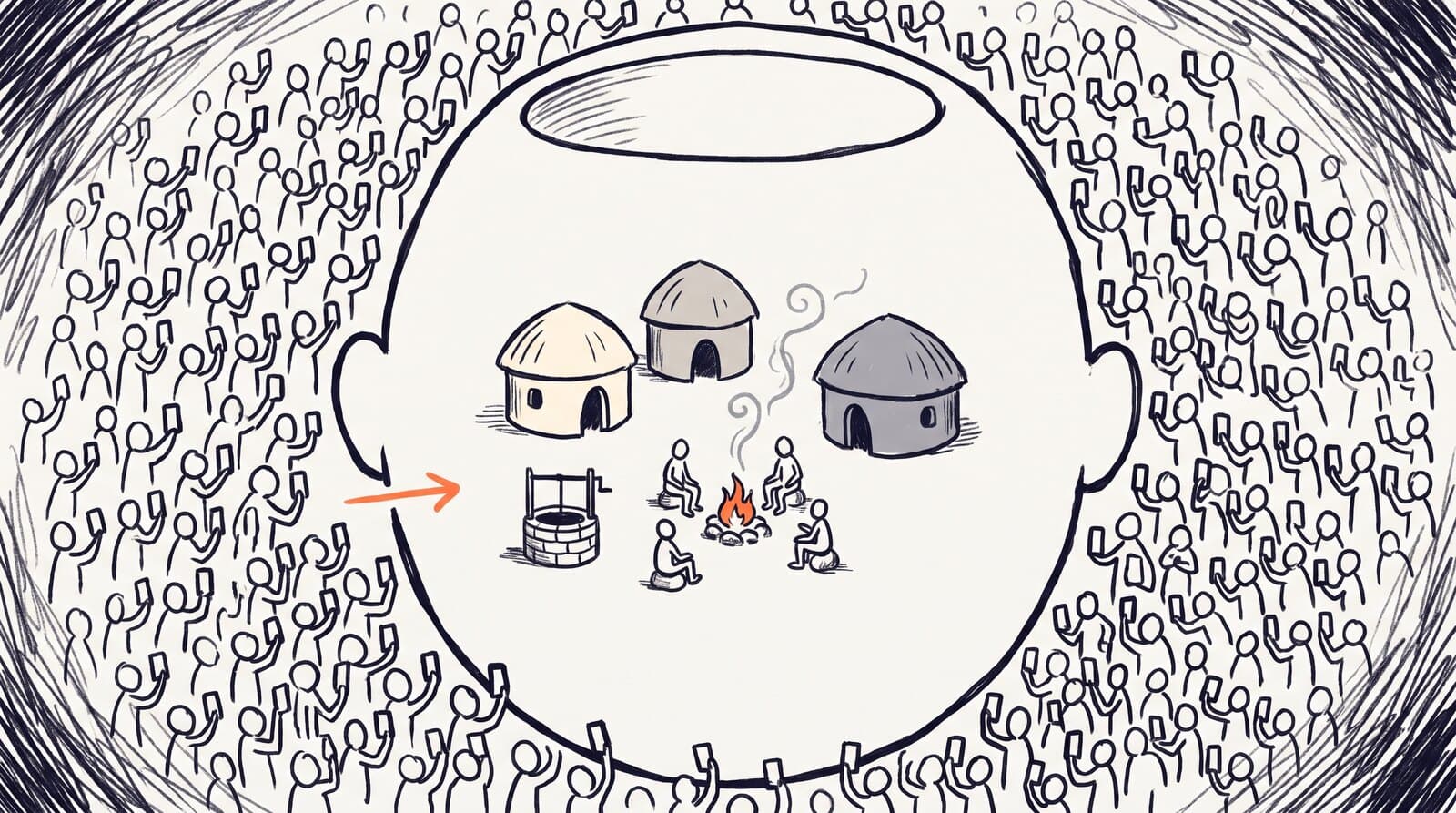
The mechanism the authors point at is comparison. Caring where you stand in the group kept your ancestors alive. Status in a band of fifty people was a survival signal, and the brain learned to treat it as urgent. The same circuit now runs against a feed with no top, where someone is always ahead of you, and the signal never arrives at "fine, you are doing well." Yong's line: "Competition is not new, but modern life can make it feel constant."
That is the part I have been saying for years, in less careful words. We out-engineered ourselves. We are good at building, and we have rebuilt the world around us many times over in the span of a few generations. The thing doing the building has not been updated. Evolution works on a clock of tens of thousands of years. We shipped the smartphone in 2007.
The review draws on existing research rather than new data, and the authors say so; it is a framework, not a verdict. But it fits something you can check against your own week. The overload sits in your head because your head was never the right size for this, and for no other reason.
The seesaw that keeps you coming back
Mismatch explains why the feed hurts. It does not explain why you keep reaching for it. For that, the best model I know is in Anna Lembke's Dopamine Nation, from the Stanford psychiatrist who runs the university's addiction clinic.
Her picture is a seesaw. Pleasure and pain are processed in overlapping parts of the brain, and the system wants to sit level. Press the pleasure side down with a hit of novelty, a like, a new tab, and the brain answers by loading weight onto the pain side to bring the plank back. The weight lands after the pleasure fades, which is the small, restless dip you feel when the scroll ends. With repetition the pain side gets heavier and stays loaded. The baseline drops below level. Now the same hit only brings you back to neutral, and without it you sit under water.
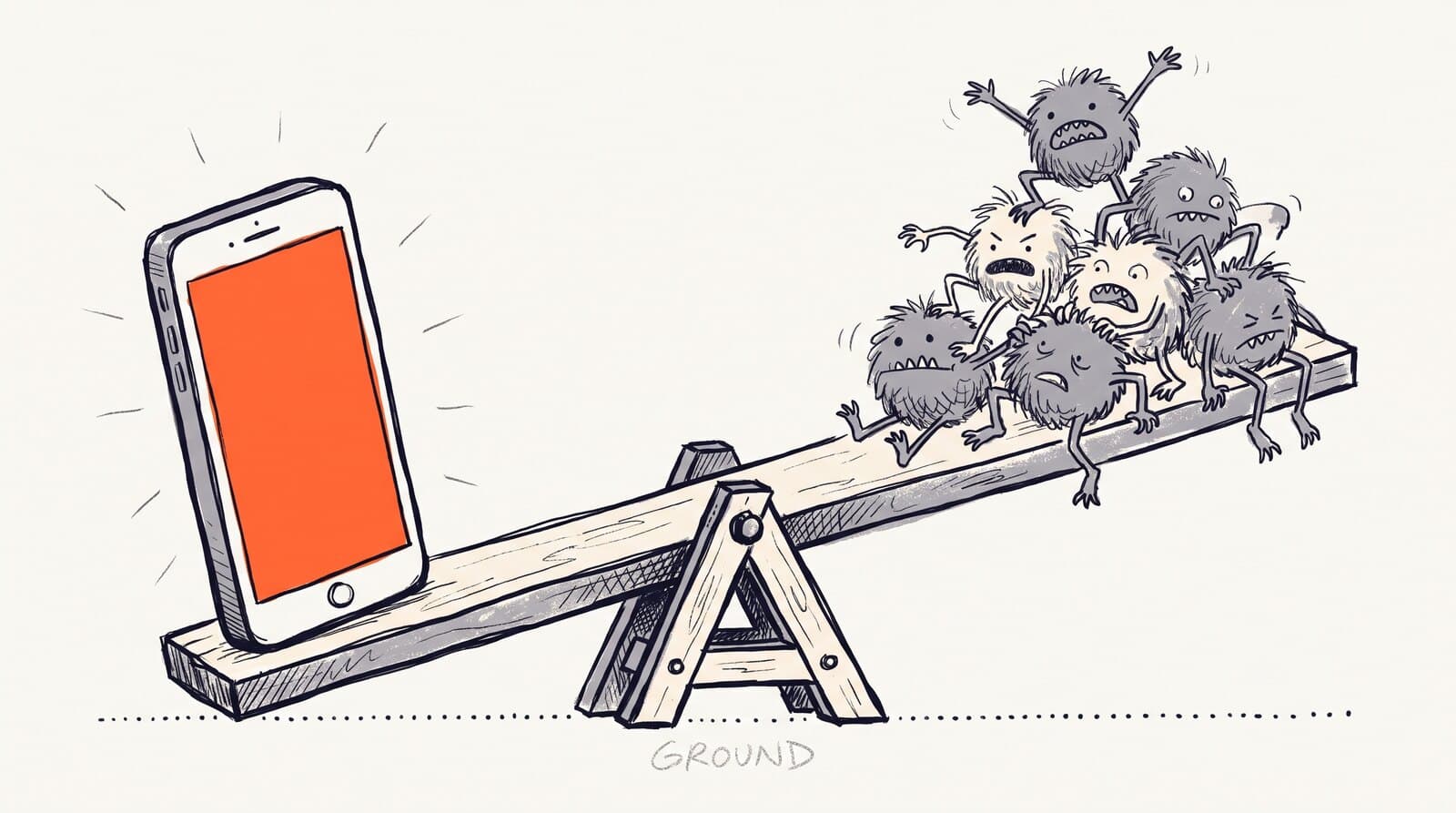
Lembke's word for the phone is blunt. She calls it the modern-day hypodermic needle, delivering digital dopamine around the clock. I would add that it is a needle you are expected to use at work. The founder's feed is also where customers are, where investors look, where the next hire reads about you. You cannot simply put it down, which is exactly what makes it the hardest input to govern.
Put the two models together and the shape of the problem is clear. A brain tuned for a village is being fed a city's worth of comparison, through a channel engineered to keep the seesaw loaded. Tolerance, background anxiety, a day that does not register. None of that is a diagnosis. It is the predictable output of the setup.
Contentment is a baseline, not a peak
A while ago I started a self-experiment I call Untroubled. The Greeks had a word for the target, ataraxia, which translates roughly as untroubledness. Epicurus, who is remembered as a hedonist and was closer to the opposite, defined pleasure as the absence of disturbance, not the presence of stimulation.
The thesis I landed on, after a lot of reading and a 30-day reset in the desert, fits in one sentence. Contentment is not a peak state to be chased. It is a baseline to be recalibrated to.
That changes what the fix looks like. You cannot add your way out of a loaded seesaw. Another app, another supplement, another routine stacked on top of the inputs only presses the pleasure side further down. The only thing that lets the plank come back up is subtraction. Take the supernormal inputs away for long enough and the baseline recovers on its own. Small things start landing again. A meal tastes like something. A quiet hour is quiet, not boring.
This is also the point where I want to be careful, because the obvious conclusion is wrong. The answer is not to leave. Antibiotics, plumbing, the internet, friendships that span continents, the ability to build a company from a cabin: all modern, all good. I am not interested in dropping out, and neither are you. The work is to be in modernity without being captured by it. Off-grid, online. The discipline is the oscillation between the two.
What to subtract, in order of effort
None of this requires buying anything. Most of it requires stopping something.
1. Give every input a limit before you touch it
The test I use for whether a modern input is a gift or a hijack has three parts, and the third is the one that matters. Does it deliver more short-term reward than long-term value? Does it shape you to want more of it over time? And can you stop at a limit you set before you started? One scroll in the morning, one episode, one check of the feed. One slip is a bad day. Two in a row mean that input, for you, right now, is running you. Expect the test to sting a little; it did for me, with chewing gum of all things.
2. Stop treating strangers' news as yours
The mismatch review's sharpest observation is that the brain treats information about billions of strangers as immediately relevant, even when you can do nothing about it. You can do nothing about most of it. A raise you cannot affect, a launch in a market you do not serve, a feud between two people you will never meet. Mute the accounts that only ever produce comparison. Unfollow the ones whose wins read as your losses. The village brain needs a smaller village, and you get to pick who lives in it.
3. Batch the window
The feed is dangerous as a background process, not as a task. Decide when you will be on it and for how long, do it on purpose, and close it. Two windows a day, both with an end time, beat an open tab that pulls at you between every line of real work. If you need to be reachable, be reachable through one channel with a sound, and let the rest wait.
4. Leave the quiet empty
The baseline recovers in the gaps. A walk without a podcast. The thirty minutes after dinner with nothing in your hands. The brain uses that unstimulated time to settle the seesaw and consolidate the day, and modern life has engineered the gaps out of existence. Put them back on purpose, thirty minutes a day, and defend them like a meeting.
5. Decide once instead of daily
The most expensive inputs are the ones that ask you the same question every day. What do I post. Should I react to this. Have I said anything this week. Each one is small, and each one is a tax on the same limited bandwidth that everything else draws from. Anything you can decide once, with a rule, and then stop deciding, is bandwidth returned to the work that only you can do.
Where Borker fits
One of those daily questions is the one we built a product around. For a founder, "say something today" is a standing obligation with no natural end, and it keeps the feed open as a side effect. The account needs tending. The tending needs the feed. The feed loads the seesaw.
Borker takes that one question and answers it once a week. It learns how you actually sound, from what you have already written and the rules you keep. It watches what is happening in your world, your own work, the sources you follow, and writes the week of posts ahead. You read them in one sitting, approve the ones that are you, fix the ones that are not, and close the tab. When you want it, autopilot sends them without you, and the sensitivity and quality gates still apply.
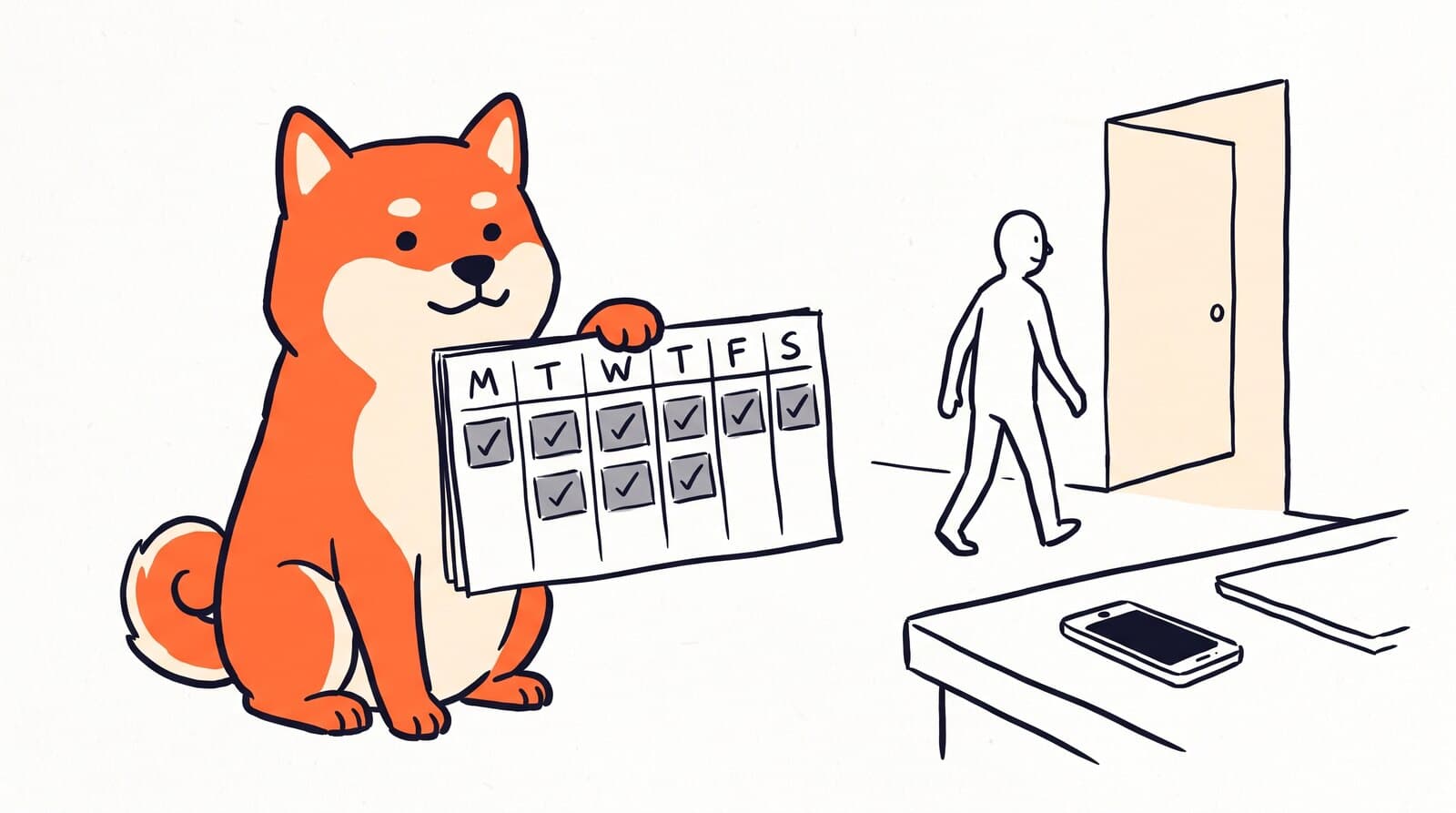
That is the whole claim. No bigger audience, no persona. One recurring decision removed from the daily load. The bandwidth it was taking goes back to building. Once Borker knows how you talk and what you talk about, the question of being present online stops being a question you answer thirty times a day.
Doing it by hand
You can get most of the same relief without any product, and the cost is worth knowing before you choose.
| Step | What it takes by hand |
|---|---|
| Write a week of posts in your own voice | One sitting of two to three hours, every week, plus the discipline to actually do it on the same day |
| Keep a list of what is happening in your world | A notes file you update whenever you read something worth reacting to, and read again before the sitting |
| Keep the voice consistent across channels | A written rule sheet: words you use, words you never use, how long you go on each platform |
| Not open the feed in between | A rule, and someone or something that holds you to it |
If you can keep that going for a quarter, you do not need us. Two weeks is about how long it held for me, and for everyone I have watched try it. Then the daily question comes back, and the tab comes back with it. The seesaw wins.
The question is not how much, but how much lands
I used to measure a day by how much I squeezed out of it. The more I read about the brain I actually have, the less sense that makes. Could the day have held more? Sure. But so what. A day where the small things register beats a day with more things in it that you did not feel.
We built a world faster than we could grow into it. Tearing it down is no answer, and neither is toughing it out. Take a few things away, on purpose, and see what comes back.
New here? Borker is the AI content engine for founders.
We learn your voice, watch your news feeds, and ship posts to X, LinkedIn, Farcaster and your blog while you build the actual product.