How to write tweets in your own voice with AI
By the Borker Team
Search for "AI tweet generator" and you'll find a hundred tools that all produce the same tweet. You know the one. It opens with a hook it learned from a viral thread in 2023, includes exactly one emoji, and ends by asking an engagement-bait question nobody will answer.
AI can write. What it can't do out of the box is know who's speaking. This post is about fixing that: what actually makes text sound like a specific person, and a practical system for teaching that to an AI, whether you use Borker or build your own setup with a chat model.
🚀 Big news! We're thrilled to announce that scheduled publishing for LinkedIn is officially LIVE! Say goodbye to manual posting and hello to effortless content management. Try it today! #productivity #socialmedia
scheduled publishing now works for linkedin. queue it monday, it posts thursday, you never think about it again. one less tab open.
Your voice is a set of decisions, not a vibe
"Write in my voice" fails as an instruction because a model can't act on it. Voice feels like magic, but it decomposes into concrete, repeatable decisions:
- Register. Do you write "we shipped it" or "we are pleased to announce"? Contractions or no contractions?
- Rhythm. Short punchy fragments? Long sentences that build? Where do you break lines in a tweet?
- Vocabulary. Every founder has maybe twenty load-bearing words. The ones you always use ("shipped", "gnarly", "footgun") and the ones you'd never touch ("leverage", "delve", "game-changer").
- Stance. Are you the excited builder, the skeptical engineer, the helpful teacher? What do you make fun of? What do you refuse to hype?
- Formatting tells. Emoji or never. Hashtags or never. Threads or single posts. Links in the post or in a reply.
Once you see voice as decisions, the path is obvious: don't ask the AI to guess the decisions. Hand them over.
The system: context beats cleverness
Here's the approach that actually works, in increasing order of effort. Each layer compounds with the previous one.
1. Collect your real posts (not your favorites)
Grab 15 to 30 of your actual tweets. Not just the winners. The ordinary Tuesday posts carry more voice signal than your one viral hit, because the viral hit is often the least representative thing you ever wrote.
If you're mostly starting from zero on X, pull from wherever you already write honestly: commit messages, Slack, a newsletter, README files. Voice leaks everywhere.
2. Write down your never-list
The fastest quality win is negative constraints. Models respond better to "never do X" than to "be authentic." Start with the classics and add your personal allergies:
- Never open with "Excited to announce" or any synonym of excited
- Never use "game-changer", "unlock", "elevate", "delve"
- No rocket emojis, no clapping-hands-between-every-word
- Never end with "What do you think?" unless a specific question exists
- No hashtags (or whatever your rule is; the point is that it IS a rule)
3. Set the dials explicitly
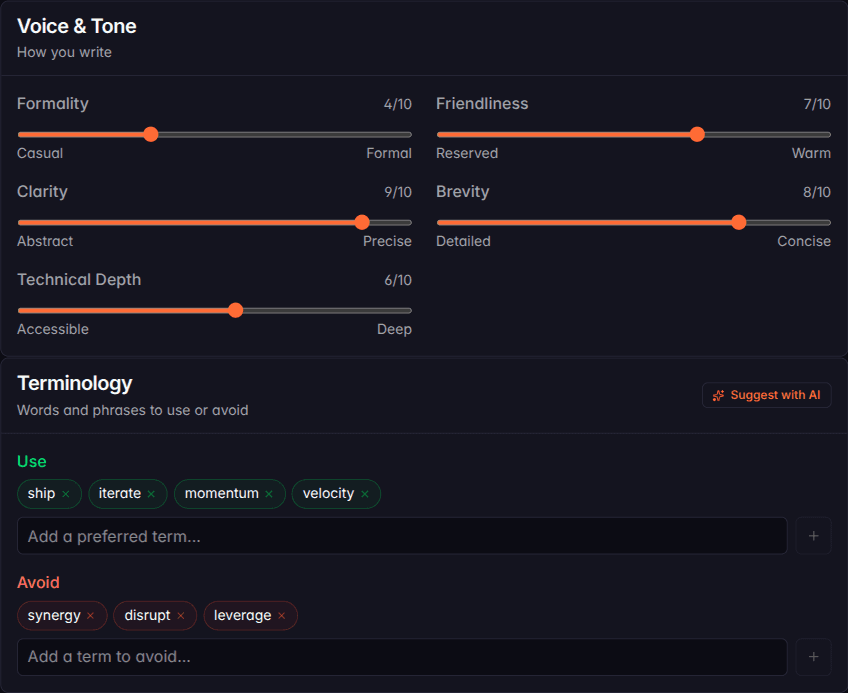
Describe your register as settings, not adjectives. "Casual but competent" means nothing to a model. This means something:
- Formality: 3/10 (contractions, lowercase openings are fine, no slang for its own sake)
- Brevity: 8/10 (cut everything twice)
- Technical depth: 7/10 (name the actual technology, skip the analogies)
- Friendliness: 6/10 (warm, but never cheerleading)
This is exactly how Borker models it internally, because numbers survive the trip through a prompt better than vibes do.
4. Show, don't only tell: worked examples
For each kind of post you write (product update, opinion, reply to news), give the AI one real example labeled "this is right" and one counter-example labeled "this is what I'd never write." The pair matters. A good example alone tells the model what to imitate; the pair teaches it where the line is.
5. Make review part of the system
Even with all of the above, you'll edit. Good. The edits are the system improving. Every edit you make is voice data: notice WHAT you keep fixing and promote it into a rule. If you keep deleting the same kind of opener, that opener belongs on the never-list, permanently.
This loop is the real difference between "AI that writes like me" and "AI I babysit forever." Systems that capture your edits get better. Chat windows forget everything by Thursday.
What this looks like in practice
Put together, the recipe for a single tweet in your voice looks like this: your dials + your never-list + two or three relevant examples + the actual thing you want to say. The last part matters more than people admit. AI can match your voice, but it can't have your day. "Spent 3 hours on a bug that turned out to be a timezone" is a tweet only you can supply the seed for.
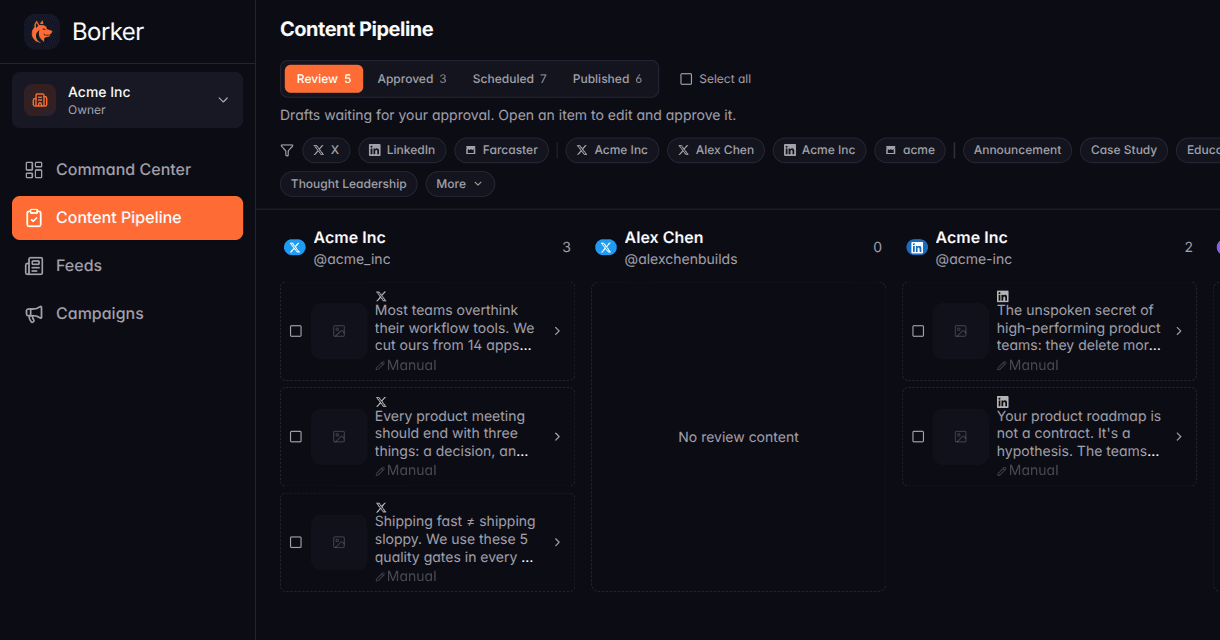
That's why the best setups separate the two jobs: you (or your feeds, your changelog, your news sources) supply the raw material, and the voice system does the shaping. Borker automates the whole pipe: it learns the decisions above from your website and your writing during onboarding, watches your news feeds and blog for things worth saying, and drafts posts in your voice for you to approve. But the principles are the same if you're pasting context into a chat model by hand every morning. It's just a question of whether you want to be the pipeline.
The 15-minute version
If you do nothing else, do this today:
- Paste 15 of your real tweets into your AI tool of choice.
- Add five never-rules from the list above.
- Set your four dials as numbers.
- Ask it to draft the thing you were going to post anyway.
- Edit, then turn your biggest edit into rule number six.
You'll get 80% of the way there, and you'll understand exactly what the remaining 20% costs: doing that setup fresh every session, for every platform, forever. If that overhead is fine, a chat model is genuinely all you need. If it isn't, that gap is why we built Borker, and the fastest way to see your own voice profile is the free brand voice analyzer. Paste your site, get the decisions your writing already makes.
Your audience doesn't follow you for content. They follow you for you. The AI's job is to sound like that, and now you know how to make it.
New here? Borker is the AI content engine for founders.
We learn your voice, watch your news feeds, and ship posts to X, LinkedIn, Farcaster and your blog while you build the actual product.